

Hitting the wrong targets
The world has a munitions problem. Global military spending surpassed $2.6 trillion in 2024 (the latest year for which there is data). That’s a 350% increase since 2000. Annual military spending has risen by one trillion dollars in just the past decade.
Meanwhile, governments are cutting funding for development and spending far less than is needed to address climate change. They claim there is no money for such things. Yet many of those same governments spend billions of dollars each year buying guns, tanks, missiles, fighter jets, and more.
Countries have a right to protect themselves. The problem is that many countries spend massive amounts on their militaries while underfunding development and diplomacy. Those programs help mitigate future risks and conflicts—at a much smaller price tag—and make military intervention less likely.
With the annual Munich Security Conference about to start, a new ONE Campaign analysis highlights just how stark the imbalance is between military spending and spending on development and diplomacy. The latter two get much less attention, but are incredibly cost-effective.
As former US Secretary of Defense Robert Gates pithily put it: “Development is a lot cheaper than sending soldiers.”
— Joe Kraus, ONE Data Senior Policy Director
3 things to know
1. The top 10 OECD defense spenders allocate $7 to defense for every $1 spent on development and diplomacy, combined. Overall, more than 85% of their security-relevant spending is devoted to defense. That leaves less than 15% for the tools that help reduce fragility, manage shocks, and sustain political stability. Those 10 countries spent a combined $1.45 trillion on their militaries in 2024, up nearly 30% over the previous decade.
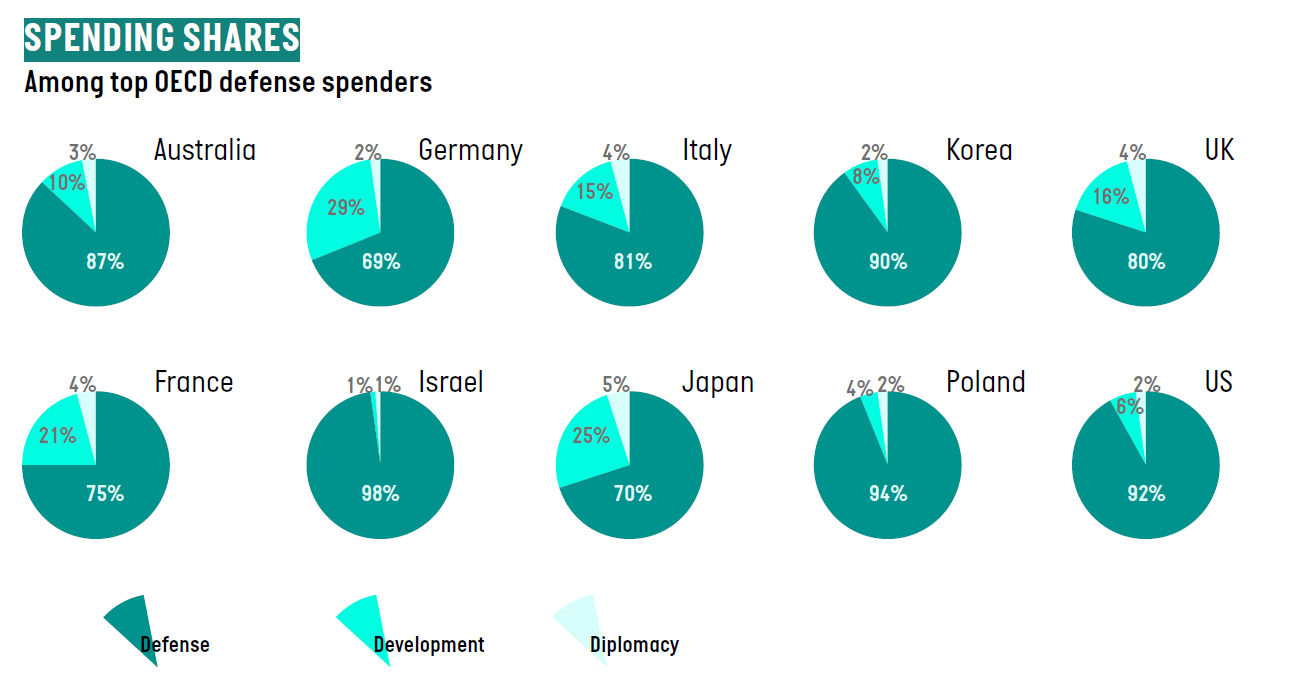
Source: The ONE Campaign
Why it matters: Investing disproportionately in defense without corresponding support for development and diplomacy may yield temporary deterrence, but it does not deliver the broader human security—health, stability, economic opportunity—on which lasting peace depends. True security is not only what protects the state but what safeguards people’s lives, rights, and resilience.
2. The top 10 OECD defense spenders spent 65 times more on defense than on global health in 2024. Spending on development by those countries has plateaued or declined as a share of GDP. Their share of development spending directed to fragile and conflict-affected states has fallen sharply, even as global fragility rises.

Source: The ONE Campaign
Why it matters: Health’s share of total development spending among these countries has declined by almost 15% over the past decade. That’s despite overwhelming evidence that strong health systems are among the most effective investments for preventing instability, protecting human capital, and reinforcing state legitimacy. This retreat from prevention is strategically inefficient. Fragile contexts now host the majority of the world’s extreme poor and generate insecurity spillovers that are far more expensive to manage with military tools than to prevent through sustained civilian investment.
3. None of the top 10 risks over a 10‑year horizon are military in nature. That’s according to the World Economic Forum’s Global Risks Report 2025. Instead, extreme weather, environmental degradation, large‑scale forced migration, and technological disruption dominate the list of long‑term risks.
Global risks ranked by severity over the short and long term
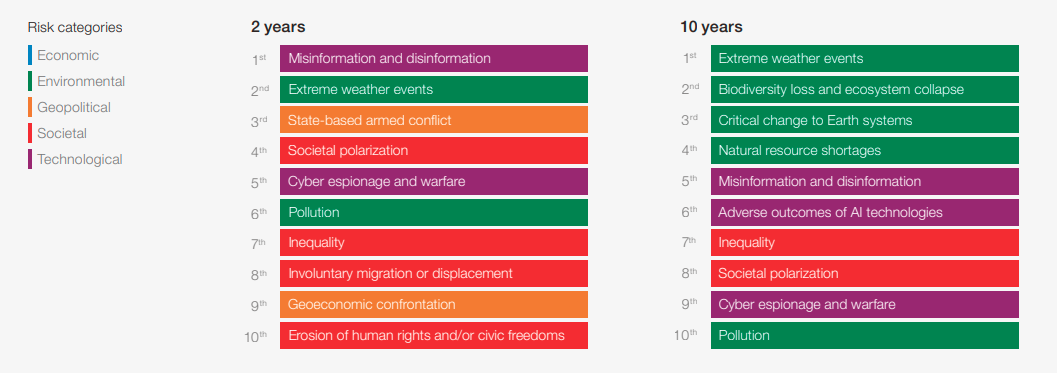
Source: World Economic Forum
Why it matters: The current one-dimensional focus on defense leaves the world dangerously unprepared for the defining security challenges of the future. Climate change illustrates this mismatch: Under current trajectories, unchecked climate change could reduce global GDP by 17% and cause economic losses of $38 trillion per year by 2050 through damage to health, productivity, agriculture, and infrastructure.
FROM THE ONE TEAM:
Analysis: Conflict prevention is 100 times less costly than crisis response.
IN THE QUEUE:
Google backs African push to reclaim AI language data
DR Congo inks AI deal with US firm to map country’s critical minerals
Trump cut the cash. The African Development Bank raised a record $11bn anyway
ONE Data provides cutting edge data, tools, and analysis so that we can fight together for a more just world. See for yourself.