

A solar take-off
One in four people on the planet will live in Africa by 2050. The continent’s population will nearly double between now and then, to 2.5 billion.
Powering that growth poses a major challenge. Currently, 600 million Africans lack access to electricity. How will African countries solve that problem and catalyse economic growth without worsening the effects of climate change already impacting them?
A few years ago, my colleague Olawunmi Ola-Busari and I wrote about how Africa—given its geographic and natural resource advantages—could become a green energy powerhouse.
There is now evidence that a “solar take-off” is happening in Africa. Should it continue to soar, it will have major implications for both the region and the world.
— Joe Kraus, Senior Policy Director, ONE Data
3 things to know
1. Renewables are the world’s fastest growing source of electricity. And it isn’t even close: They’ve grown five times faster than gas and 16 times faster than coal since 2014. Meanwhile, the use of coal and gas to generate electricity has plateaued over the past five years.
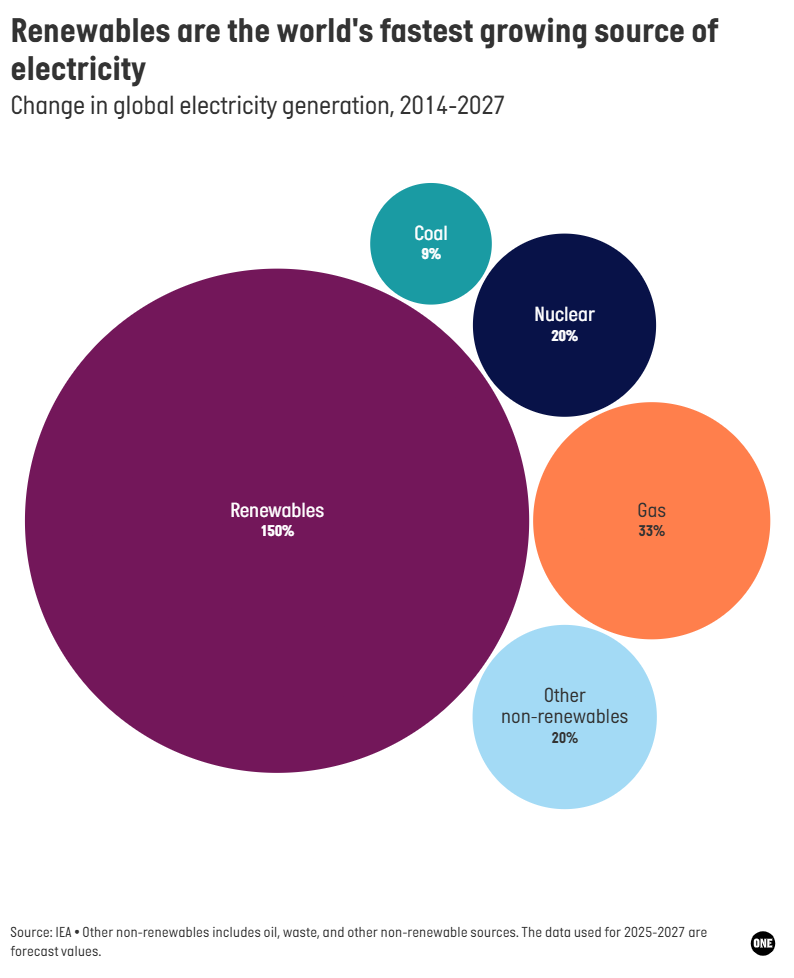
Why it matters: Readers of IPCC reports or, well, the news, are painfully aware that the world is doing a rather poor job of keeping its climate promises. But it’s not all bad news: The rapid expansion of renewable energy over the past decade has been pretty incredible. That’s especially important given the rapid population growth—and increased energy demands—in developing regions. Every solar panel or wind turbine that gets erected keeps a little more carbon in the global carbon budget.
2. Africa has 60% of the world’s best solar resources. Yet it has just 1.5% of the world’s installed solar capacity. Eighteen of the top 30 countries globally with the potential to generate solar power are in Africa. That presents an incredible opportunity—if governments can seize it. There’s evidence that they are: Africa’s installed solar increased ninefold over the past decade. And Africa’s solar imports from China (which makes 80% of the world’s solar panels) rose by 60% in 2024-25. Over half of Africa’s new electricity capacity this year will come from solar.

Source: Ember
Why it matters: In many ways, Africa is an important climate and renewables bellwether. Given its rapid population growth, rising energy needs, and enormous solar (and wind) potential, Africa will play a pivotal role in shaping the climate. If it harnesses its unmatched solar potential alongside its many critical minerals, its future looks, ahem, bright. 😎
3. 25 African countries imported at least 100 MW of solar panels in 2024-25. That’s an increase from 15 countries the year before. That could significantly boost many countries’ ability to generate electricity. For instance, if Sierra Leone installed all the solar panels it imported last year, they would generate electricity equivalent to 61% of its existing electricity. And solar is a critical part of the Mission 300 initiative, which aims to expand electricity access to 300 million people in Africa by 2030.
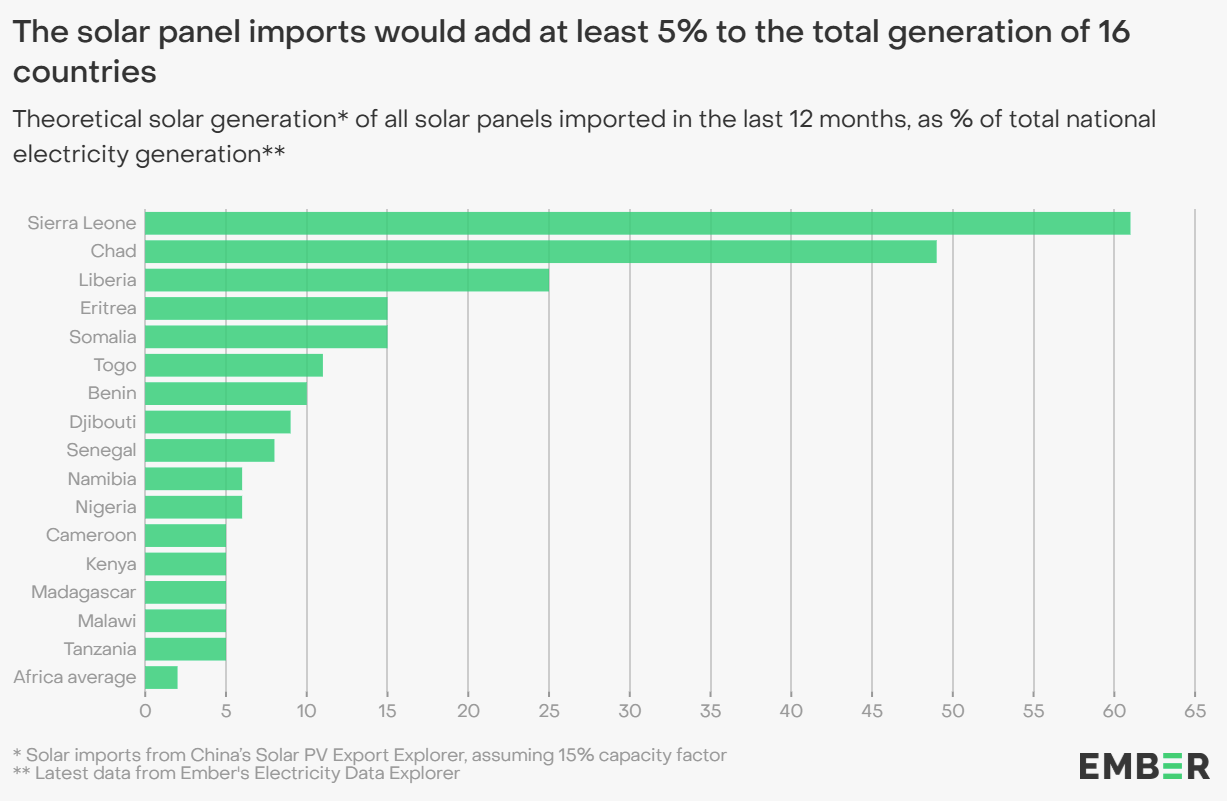
Source: Ember
Why it matters: Solar panels are cheap and getting cheaper. That makes them an appealing option, both for governments and for individuals looking to generate electricity without breaking the bank. Rooftop solar could help overcome the challenges of getting electricity to rural areas far from the electrical grid, and help cut down the number of people living without electricity. But utility-scale solar projects will be critical for ensuring that robust grid systems exist to meet the heavy electricity demands of industries and urban areas.
FIND DATA FAST:
The ONE Data Agent™: An AI-enabled tool that enables you to search tens of millions of data points on health financing in seconds.
Net flows dashboard: Tired of scouring complex databases for developing country data on debt service and loans? Same. So we built an easy-to-use dashboard.
ODA dashboard: Reliable data on aid to developing countries, searchable and downloadable by recipient, sector, and more.
Trade Explorer: Explore, visualise, and download data on annual global trade flows by country and product.
MORE FROM ONE DATA:
The answer to attacks on the UN is to revitalise it — not sideline it, says David McNair.
🎧 Must listen: David had a riveting conversation with Dan Banik about the future of activism and global development in an age of overlapping crises for the In Pursuit of Development podcast.
IN THE QUEUE:
Africa’s energy sector faces pivotal choices.
Africa needs solar farms, not just solar islands.
At the Munich Security Conference, development tried to remain relevant.
ONE Data provides cutting edge data, tools, and analysis so that we can fight together for a more just world. See for yourself.