

Religious revival
Last year, when a family member in the US had a serious health scare, I called several Catholic churches in and around the area, looking for a priest to administer last rites. I was struck by how many of the priests serving in those rural, mostly white communities were African.
That is no fluke. While the number of priests has declined in much of the world, it’s grown by nearly 3% in Africa in recent years. That has made Africa the Catholic Church’s primary source of talent.
While Catholicism’s growth in the US and other parts of the Global North has stagnated, it has surged in parts of the Global South. No more so than in Africa, where it is growing so quickly that it’s shifting Catholicism’s epicenter and soon will play a significant role in shaping the religion’s future.
— Joe Kraus, Senior Director, ONE Data
3 things to know
1. 20% of the world’s 1.4 billion Catholics are African. A century ago, it was just 1%. Catholicism has grown by more than 30% in Africa over the past decade. Africa’s Catholic population has surpassed Europe’s and now trails only Latin America. Meanwhile, Catholicism’s growth has stalled or regressed in Europe and the Americas.
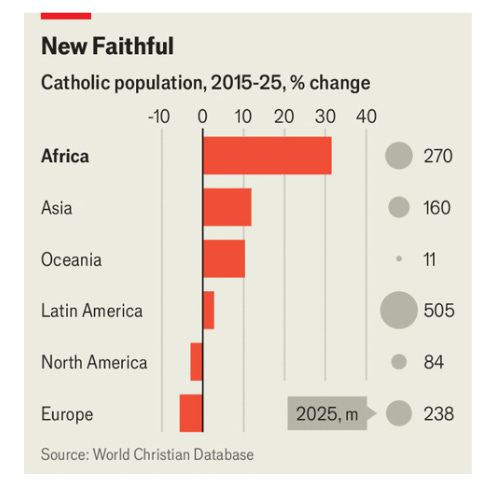
The surge in Catholicism’s popularity in Africa has been building for decades. A priest in Benin in the mid-1990s recounted seeing 10,000 people show up each week for catechism (a Catholic teaching), and cohorts of over 1,000 people per day receiving Confirmation (one of the religion’s seven sacraments). Today, Africa is the world’s only region where the number of men studying for the priesthood is increasing. If current trends continue, Africa could account for half of all Catholics by the 2060s.
2. Getting political is key to the church’s success in Africa. In a continent plagued by poverty and ineffective or corrupt governments, the Catholic Church addresses people’s needs and frustrations. It provides education: one in nine students in primary school attend a Catholic school. In many countries, it helps provide healthcare. It plays mediator during conflicts, monitors elections, champions democracy, and publicly calls out human rights violations and government corruption.
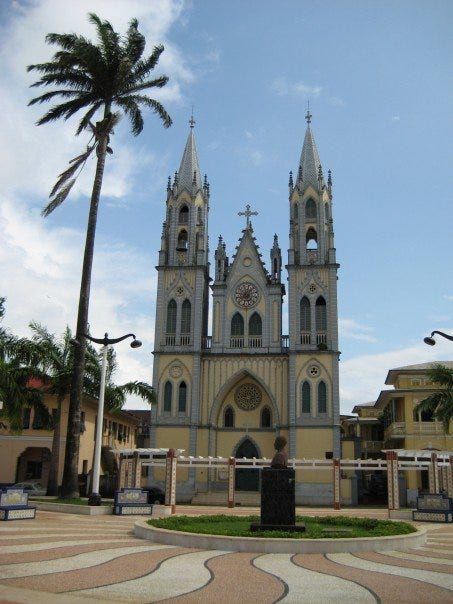
Part of the religion’s success is attributable to its ability to be relevant to people’s daily lives, both spiritually and physically. Rather than forcing people to wholesale adopt its traditions, the Catholic Church in Africa has managed to incorporate the dynamism of local cultures and traditions into something uniquely African while maintaining the religion’s core elements.
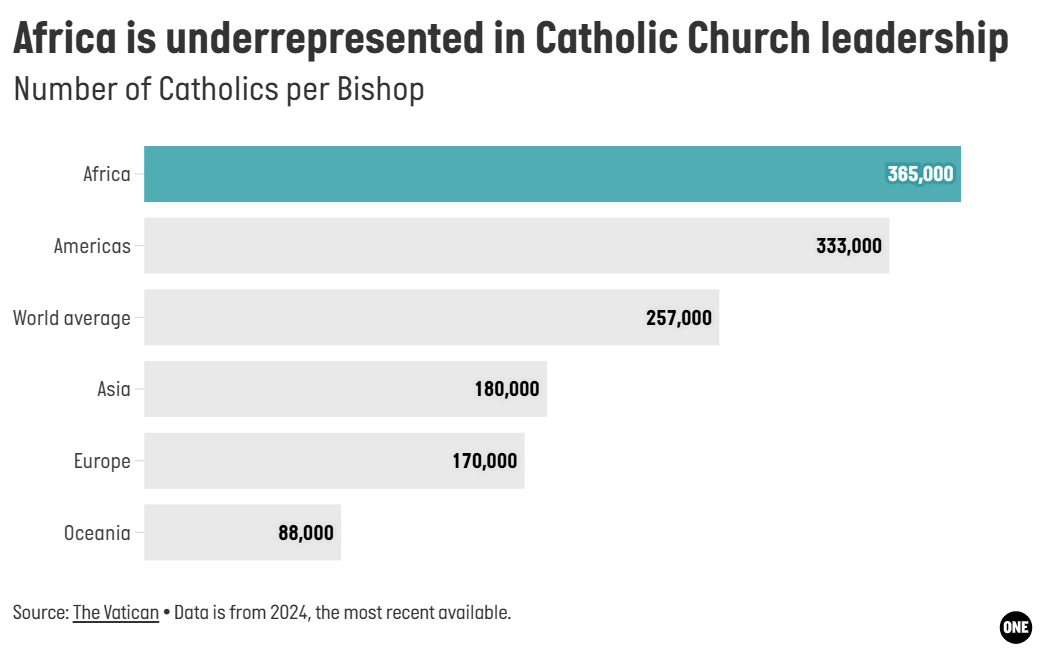
3. Africa’s representation at senior levels of the church lag behind. A pope didn’t visit the African continent until 1969, 11 days after the first man walked on the moon. The church’s disengagement with Africa has since changed: For instance, Pope Leo’s first major foreign trip—which kicks off on Monday—includes stops in Algeria, Cameroon, Angola, and Equatorial Guinea. But Africa doesn’t quite yet have full equality in the church. It has the fewest Bishops per parishioner in the world. It’s also underrepresented at the Vatican, where just 12% of Cardinals under the age of 80—the ones that select the pope—are African. That’s likely to change, eventually. Increased African representation at the Vatican seems “inevitable”, and many believe the next pope will be African.
Other issues pose challenges for the Catholic Church in Africa. They include simmering tensions between the Vatican and African Catholics on issues like same-sex marriage and LGBTQ+ rights (same-sex relations are prohibited by law in most African countries). And despite its rapid growth, African Catholicism has fierce competition: it is losing ground to Pentecostal churches, Africa’s fastest-growing Christian denomination. In addition, inter-religious intolerance has led to violence, most notably in countries along the Sahel with both sizable Muslim and Christian populations.
FROM THE ONE TEAM:
The latest ODA data signals risks to future global health, prosperity, and security.
ONE’s reaction to new figures showing the drastic cuts to UK aid in 2025.
Our ODA dashboard makes the latest aid data easy to find and use.
David McNair breaks down the latest aid cuts.
IN THE QUEUE:
How Africa is changing the Catholic Church.
How Pope Leo will approach Africa.
America’s war is adding to Africa’s debt burden.
How think tanks defeated democracy.
An ingredient added to Coke, Pepsi, and M&Ms is fuelling conflict in Sudan.
ONE Data provides cutting edge data, tools, and analysis so that we can fight together for a more just world. See for yourself.