

Hard questions, easy answers
The current Ebola outbreak in the DRC has killed over 4,300 people. I found myself wondering how much the country spends on healthcare compared with debt service, since debt payments can eat into a government’s budget. That can squeeze the amount of money available for other things, like healthcare.
So I queried a new platform that my team at ONE Data launched this week—the Development Finance Observatory—to get answers. I asked the following three queries:
“How much does the Democratic Republic of Congo spend on debt service compared to health?”
“What was the DRC’s population in 2024?”
“Use the DRC’s population to calculate how much the country paid per person in debt service in 2024.”
It took less than two minutes to get an answer. Here’s what I learned:
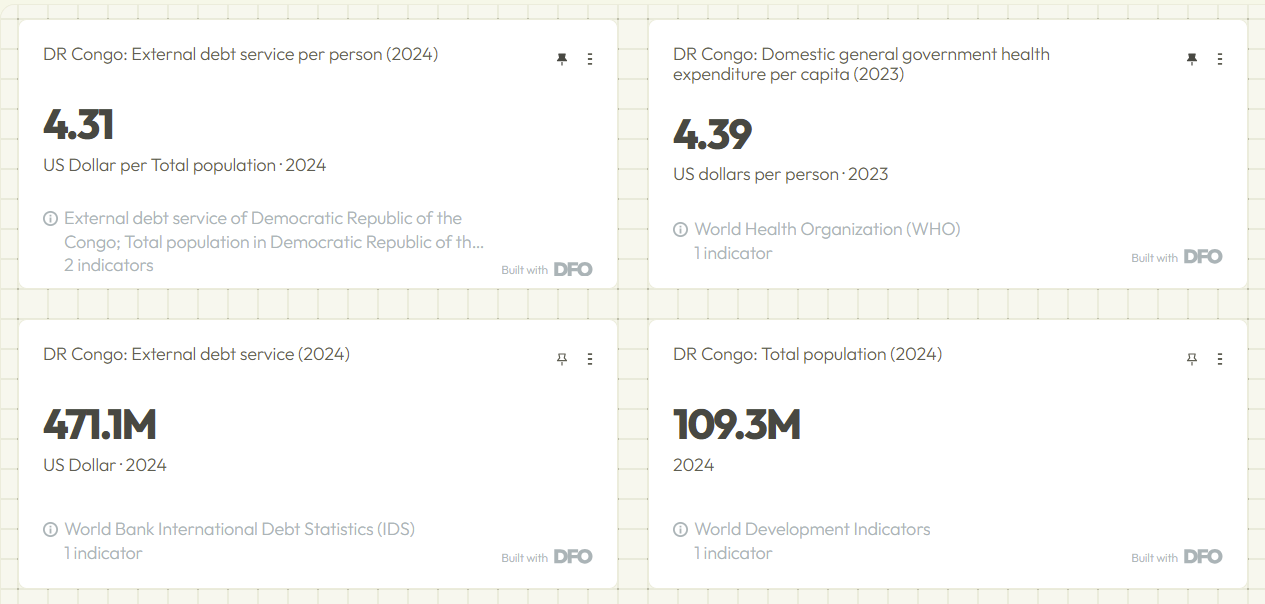
The DRC spent $4.31 per person on debt service* in 2024 and $4.39 per person on health in 2023 (the latest year for which the WHO has data). Which is kind of wild.
(* this includes principal repayments and interest payments on public, publicly guaranteed, and private non-guaranteed external long-term debt, plus IMF repurchases and charges).
Had I done the same research last week, before the Development Finance Observatory existed, it would have taken me 10 minutes. I know, because while writing this I stopped and manually searched for the data. I had to search three separate databases: the WHO’s Global Health Expenditure Database, the World Bank’s International Debt Statistics, and the UN’s Population Data Portal. Were I not already familiar with how to find and use them, it would have taken far longer, because they are fairly complex and not the easiest to navigate.
That’s the reason we built the Development Finance Observatory. To make it easier and faster for anyone—policymakers, journalists, activists, citizens—to find publicly available data.
And unlike other AI-powered tools like Claude or ChatGPT, the Development Finance Observatory can’t hallucinate. The tool can only access data that has been verified from credible sources. You can visualize or download it, and send a link of your search results to a colleague or include it in a report’s citation.
It isn’t perfect (yet). We’re still working out some glitches and will continue adding new data sources and functionality. But it’s already made finding data and getting reliable answers faster and easier. And will only continue to get better.
We hope you’ll give it a try (and email us your suggestions at data@one.org).
— Joe Kraus, Senior Policy Director, ONE Data
EARLY PRAISE FOR THE DEVELOPMENT FINANCE OBSERVATORY:
“For all of us who live by the saying, ‘What gets measured, gets managed,’ we have a welcome new option in our development toolbox.”
— Amina Mohammed, UN Deputy Secretary-General
“The data exists. It’s just scattered, inconsistent and hard to use, and the people who need it most often have the least access to it. The Development Finance Observatory changes that.”
— Paschal Donohoe, World Bank Managing Director
“For too long, critical global aid, lending, and debt data has lived scattered across isolated databases. Today, ONE Data has launched…a world-class, AI-powered platform designed to eliminate these blind spots.”
— Maggie Johnson, Global Head at Google.org
“It connects the dots. Combining datasets is one of the most time-consuming parts of this work. The Observatory lets you link related datasets quickly.”
— Kalpana Kochhar, Interim President, Global Policy & Advocacy Division, Gates Foundation
“ONE Data has just launched an incredibly useful website.”
— Al Kags, Social entrepreneur
The Development Finance Observatory is “like having an analyst in your pocket.”
“New Development Finance Observatory puts numbers behind Africa’s development in journalists’ hands.”
FROM THE ONE TEAM:
David McNair on what’s next for the Development Finance Observatory.
IN THE QUEUE:
Is manufacturing still a viable path to development? (spoiler: no, but there’s a better question to ask)
ONE Data provides cutting edge data, tools, and analysis so that we can fight together for a more just world. See for yourself.