


This is a joint post between The Insider from ONE Data and Sense of Things by David McNair to mark the launch of a new platform—the Development Finance Observatory—that we believe will make the development sector faster and better. More importantly, it will help ensure that every development dollar is spent more efficiently and effectively. Below, we explain why we built it, the impact we hope it will have, and how you can use it in your work.
Conversations about public finance are currently dominated by one key message: There’s not enough money.
The IMF this week warned that advanced economies are heading for the biggest budget deficits since COVID and urged governments to take “urgent” action to rebuild their public finances as average net borrowing hit 5.2% of GDP.
In developing countries, aid cuts have left institutions and programs reeling from a lack of resources. Fiscal pressures—from debt to energy costs—are limiting the options available to governments around the world.
And so commentators, advocates, and development leaders deride cuts, encourage pledges, and push innovations to leverage more capital from development banks and private sector players.
That there is a lack of money is undeniably true.
We’re seeing the impacts of tightened budgets at both the institutional and project levels. In the wake of a 23% cut to Official Development Assistance in 2025, a survey of HIV service providers in 40 countries revealed that more than half had run out of an HIV product in the past year. In 22 of the 40 countries, providers were running low on HIV tests or had none.
The lack of money also is visible at the macro level. Robert Lucas, the Nobel laureate economist, made the point back in 1990 that uneven development is, at its core, an issue of uneven capital allocation. It is concentrated in some places, scarce in others.
But something else is also true. Money is flowing into a system that could be considerably more efficient and impactful.
To give credit where credit is due, some governments have substantially improved the quality of spending through practical reforms:
Uganda cut the capture of school grants from 80% to under 20% by publishing transfers in newspapers.
The state of Bihar in India tied fund releases to actual spending, cutting employment-programme costs by 24% with no loss of jobs. Andhra Pradesh’s biometric smartcards reduced leakage by about 40%.
Ukraine’s ProZorro e-procurement system saves more than 5% on tenders, and over 10% through its online catalogue, compared with buying outside it.
Brazil used random audits to reduce municipal corruption by 8%.
Togo raised its public investment efficiency by five percentage points after introducing cost-benefit analysis for all projects and multiyear planning.
Rwanda’s results-based payments to clinics raised births in health facilities by 23%.
But often the real-politik of institutional incentives, graft, the challenges of operating in high risk environments, and siloed institutions makes reforming systems at scale a major challenge.
A six trillion dollar opportunity
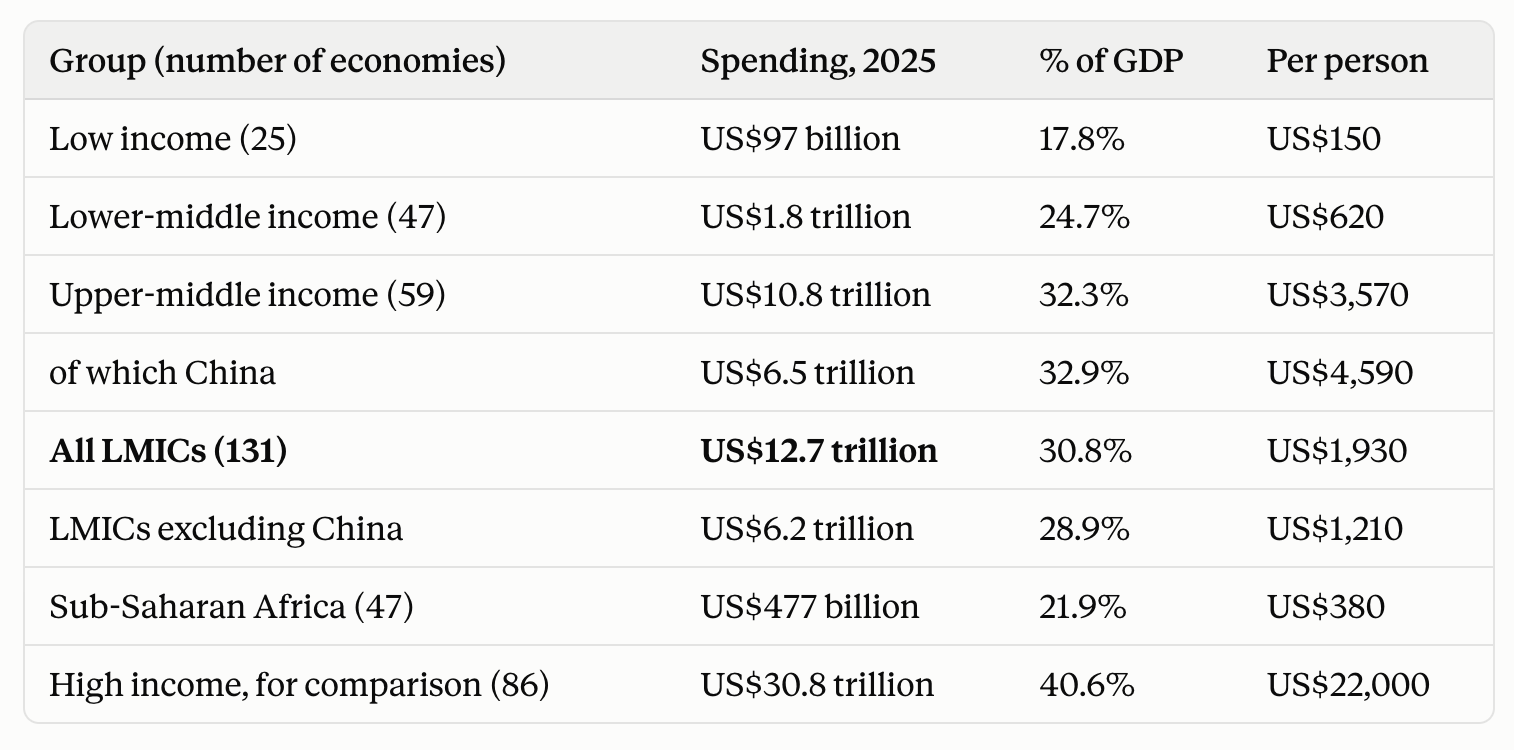
There’s considerable variance in spending across countries. Low-income countries spend just $150 per person per year, compared to $22,000 in high-income countries. The not enough money point is true across many countries.
But it’s important to recognise just how much money is already being spent:
$97 billion in low-income countries in 2025
$1.8 trillion in lower-middle-income countries
$4.3 trillion in upper-middle-income countries, excluding China
That sums to $6.2 trillion spent by low- and middle-income countries (excluding China) in 2025.
Now imagine we could increase the quality of at least some of that spending so that it delivered more impact for people, the planet, economic transformation, and meaningful development.
A quick scan of the literature offers a range of estimates to assess the sums of money lost to inefficient or wasteful spending, based on two proxies:
Efficiency gaps: Outcomes that fall short of what the best performers achieve with the same money. The main estimates come from the International Monetary Fund (IMF) (2025).
Measured waste: Money lost to overpricing, excess payroll, and leakage. The best estimate comes from the Inter-American Development Bank (IDB) (2018, an estimate specific to Latin America). This is money related to procurement, payroll, and transfers that miss their targets.
If we apply these two institutions’ estimates across all spending by low-and middle-income countries, we get the following range:
Efficiency gaps in investment, health, and education come to about US$0.9 trillion. If the same gaps applied to all non-interest spending (money the government spends on programs as opposed to debt service), the figure would rise to US$1.8 trillion.
Measured waste is about US$1 trillion a year, or 16% of spending.
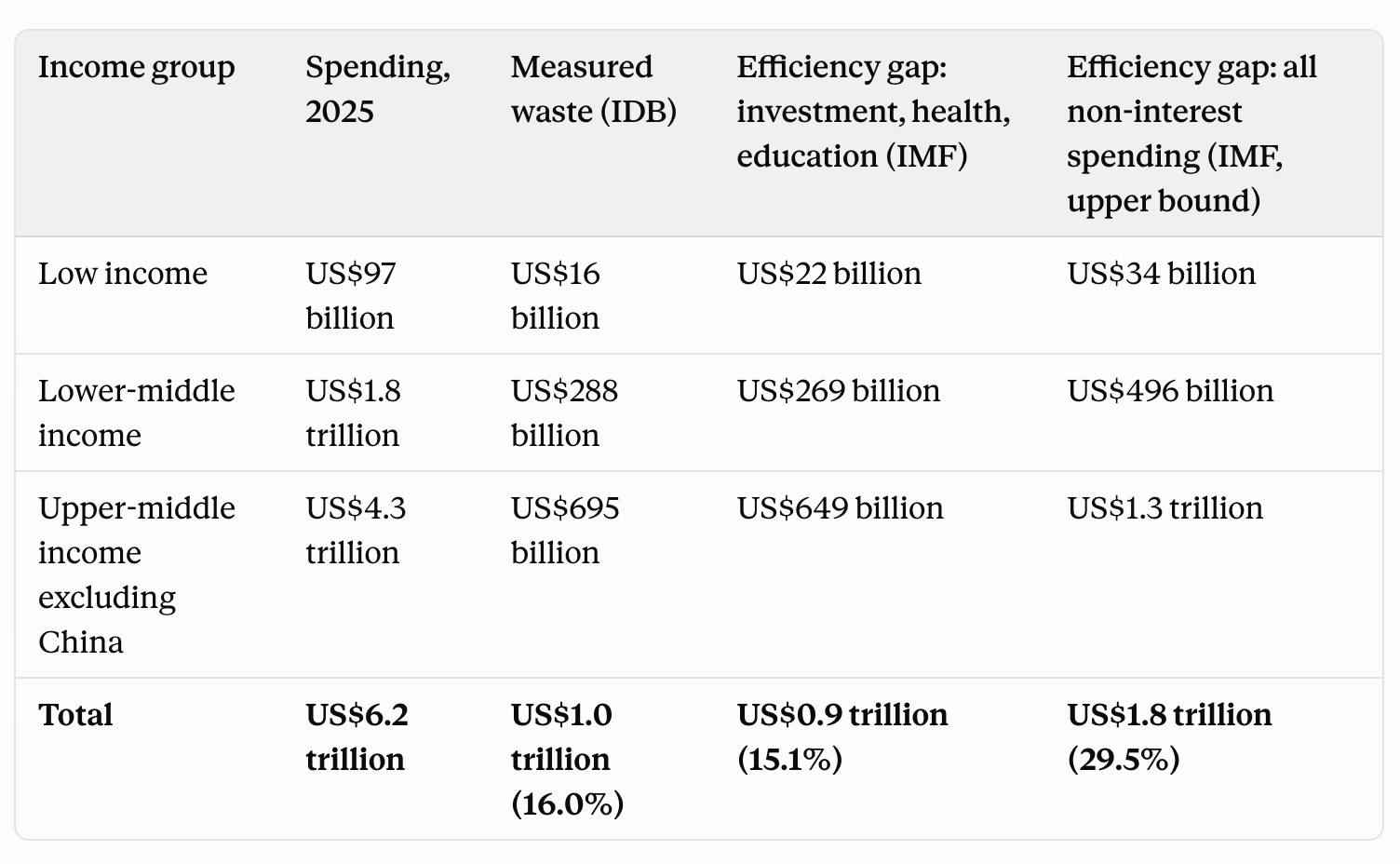
Of course, these estimates should be taken with a pinch of salt—they are taking studies relevant to particular contexts and extrapolating them.
But they are estimates from credible institutions. If we use them even as rough indicators of quantum, they point to something we all can likely agree on: governments move a lot of money that could be better spent.
AI and the Third Wave of philanthropy
Inefficient or wasteful spending is an age-old problem. Governments don’t always spend well in advanced economies, and likely even less so where states are weak.
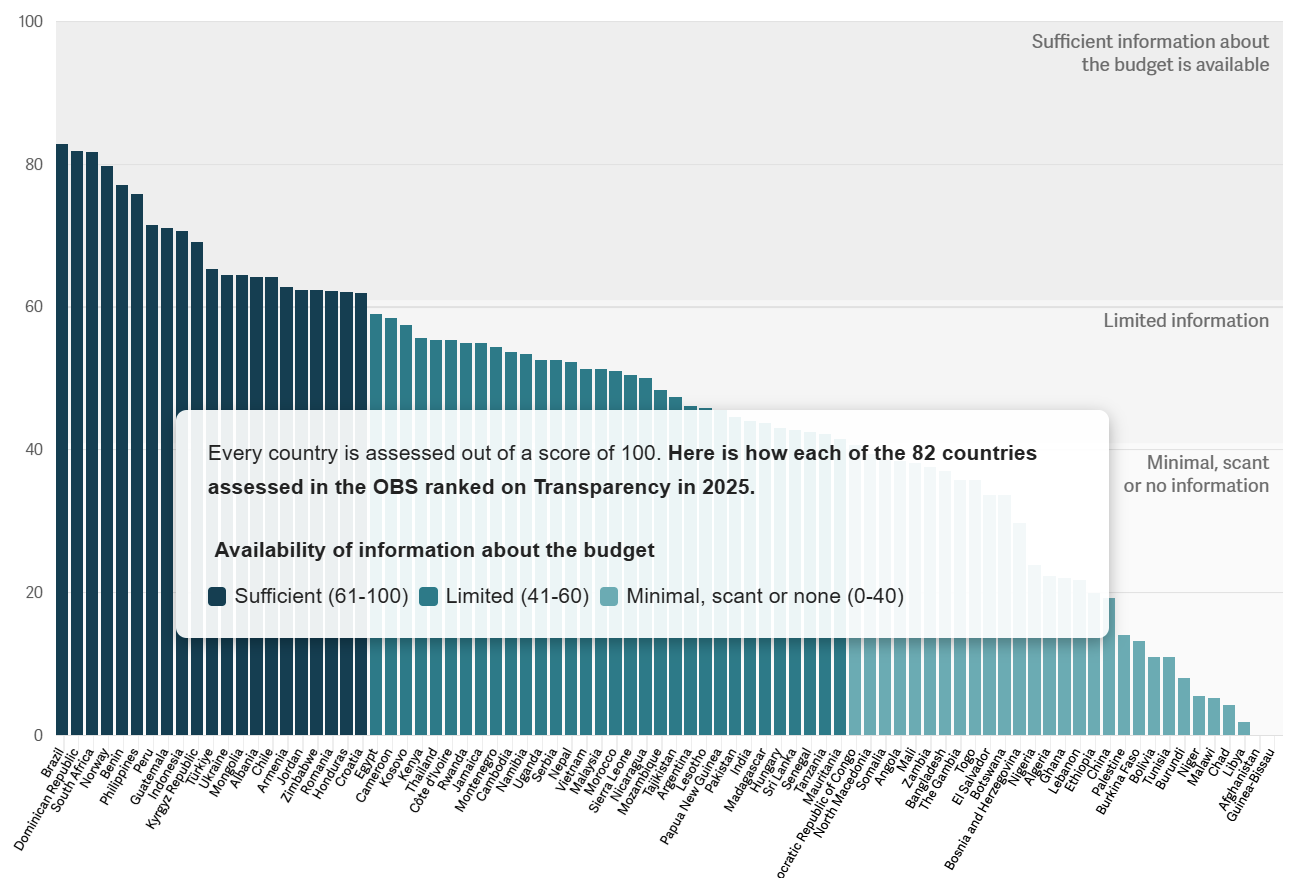
An entire community of experts has been working for decades to improve transparency, accountability, and public financial management, ranging from IMF officials to civil society.
So what’s different now?
Recent technological innovations have made it easier than ever to follow the money, giving us a chance to do things differently. They could empower policymakers with tools they previously didn’t have. They could more efficiently put government services in the hands of citizens. They could increase transparency and accountability.
AI has also been a much-discussed topic: its risks to the global economy, its opportunities to accelerate productivity.
Those two topics—AI and lack of money—have converged in the non-profit sector. The debate is centred on how organisations can tap into philanthropic capital that could flow from the new wealth created by AI labs. Nan Ransohoff estimates that this “Third Wave of Philanthropy” could be in the range of $37 billion to $100 billion per year. Even at $50 billion a year this money could fund the equivalent of six Gates Foundations (~$9B/yr), 67 Coefficient Givings (~$1B/yr), 100 GiveWells (~$500M/yr), and so on.
Most of that debate seems to focus on how NGOs, multilateral institutions, advisory firms, and consultants can connect their existing pipes to this money tap, turn it on, and get back to “normal”—normal meaning pre-2025.
I don’t believe those in control of that money think that way at all.
They made their money fundamentally disrupting how we manage knowledge as a species—so why would they use their philanthropy to fund the status quo?
This could be a good and a bad thing.
We know that techno-solutionist approaches that aren’t rooted in really understanding problems won’t be sustained. If they aren’t embedded in governance and cultural change they won’t yield transformational change. If people don’t have access to energy, skills to use the technology, or the technology itself, the impact isn’t going to go far.
But the new philanthropy could also create major new opportunities, empower people with knowledge to make better decisions, and rewire systems that no longer—or never did—work.
What if, rather than plugging $50 billion into the existing system, we used some of that money—plus the technology that created it—to unlock the $1-2 trillion being spent sub-optimally every year?
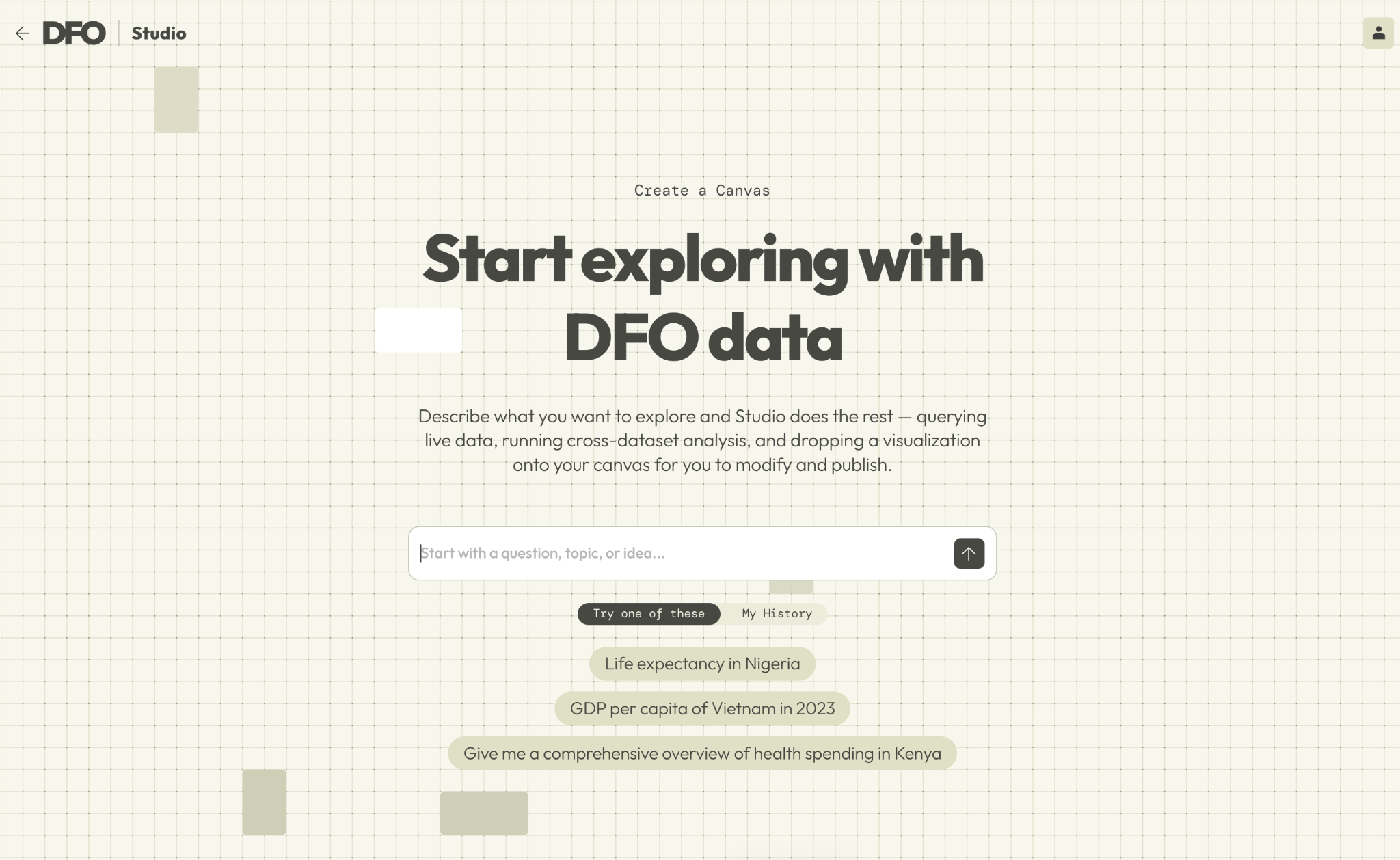
Enter the Development Finance Observatory
The Development Finance Observatory is ONE Data’s modest contribution to re-wiring the system, replumbing the pipes, and reimagining the $6 trillion already being spent by low- and middle-income countries.
The idea is simple: We live in a world in which social media influencers get detailed, real-time data on everything they do and say publicly. Policymakers—who make decisions over billions of dollars affecting millions of people’s lives—rely on patchy, often outdated numbers.
We believe policymakers—and the people that inform and influence them—deserve better.
So we partnered with Google and The Rockefeller Foundation—along with many others, such as the Gates Foundation, SEEK Development, and the International Aid Transparency Initiative—to fix this.
We undertook a massive data engineering task to connect fragmented datasets across debt, domestic spending, aid, and other financial flows, and asked leading development finance experts to train an AI tool that allows you to interrogate it.
So if you are:
A finance minister
A government adviser
A journalist
An NGO staff member
A researcher
A citizen worried about your tax dollars
… you can simply ask a question and get a fully referenced answer, complete with data, charts, and methodology, from verified, credible sources that you can trust.
You don’t need to be an expert, or even know exactly what you’re looking for. You can simply describe the kind of data you want in plain language and it will source it for you, ready to download. If there isn’t sufficient clarity in your request, the tool will ask follow-up questions to help guide and refine your search.
You can connect the Development Finance Observatory to Gemini, Claude, ChatGPT, etc. to integrate it into your own workflow.
As of today, the Development Finance Observatory includes:
100,000 indicators
Covering 1,300 places and organisations
Including growth, inflation, budgets, debt, aid, and trade.
You can view all of its current sources here—everything from the IMF World Economic Outlook to Mongolia’s national statistics, from US Labour Force Statistics to the World Health Organisation’s Global Health Observatory and the UN’s Office of Drugs and Crime.
This is just the start of the journey. The Development Finance Observatory doesn’t (yet) contain every relevant dataset. We are continuing to add new datasets—let us know which ones you’d like to see added. And we are gathering feedback on what doesn’t work (let us know if you encounter any issues), and which questions it doesn’t currently answer.
We’ve started with credible and commonly used data and have a roadmap for building this into a much more comprehensive system.
Here’s an example: Using the DFO connected to Claude, we wanted to map funding for malaria prevention against the incidence of malaria and produce a 1-page briefing. The kind of thing that might have taken a day—or at least a morning—in the past.
We typed in one sentence, and worked on something else for a few minutes. When we returned, the briefing was complete.
From sparkly tech products to systemic impacts
Fancy tech products can be like coffee table books—they look nice but often sit unused. But when used, they can open up realms of possibility.
There are an estimated 45,000 active international organizations in the world. Imagine, hypothetically, that all of them deal with finance in some fashion.
And imagine (modestly) that each has a policy team of three people who each work 40 hours a week. They spend roughly 20% of their time sourcing data with which to write reports and briefs.
That adds up to over 1,000 hours a year for each organisation, or 45 million hours across the globe every year. Time that could be freed up to work on more impactful things.
Now apply the same logic to 192 governments, millions of NGOs and journalists, billions of citizens.
On efficiency grounds alone this is a powerful approach, but even more powerful is that each one of these organisations and people can get faster, more accurate answers with which to make better decisions.
The Development Finance Observatory is just one small part of an ecosystem of actors seeking to have systemic effects on how public money gets used.
But it is a practical example that we built.
For you.
Please let us know what you think.
You can watch a short trailer of the DFO here.