

Leaky lifeboat
The pandemic, the war in Ukraine, the Iran War. All of these are crises that Africa didn’t create, but got hit hard by nonetheless. Countries already struggling with high levels of poverty and debt have had their problems compounded and their belts tightened.
Then along came sudden, sizable cuts to aid, which had provided a (sometimes literal) lifeline.
The cuts have jeopardised millions of lives and billions of livelihoods.
New analysis by The ONE Campaign quantifies the size of G7 countries’ aid cuts to Africa and what they could mean for a continent already struggling on multiple fronts.
— Joe Kraus, Senior Director, ONE Data
3 things to know
1. G7 per capita aid to Africa fell by nearly one-quarter between 2021 to 2024. It dropped from $37.8 per person in 2021 to $28.6 per person in 2024 (in constant 2024 dollars). That means that G7 aid to Africa was $9.15 lower per African person in 2024 than it was just three years earlier. That figure takes into account Africa’s 2.5% yearly population growth over that period.
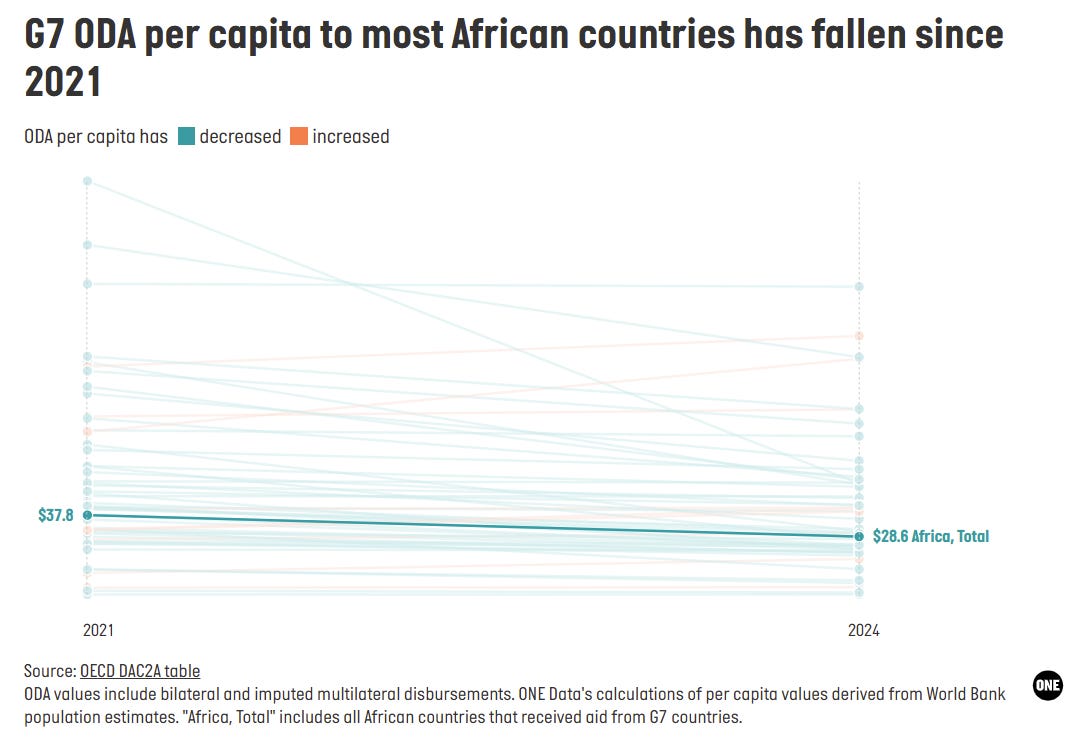
Why it matters: G7 leaders are asking African countries to manage more frequent global shocks, protect their populations from imported inflation, invest in resilience, and stay on track toward long-term development goals, with less support. Aid is not the only answer to Africa’s financing challenges. But for many low-income and crisis-affected countries, concessional finance remains one of the few sources of funding that can support basic services, humanitarian needs, and long-term investment without adding to debt stress. That makes the decline in G7 aid per person especially worrying.
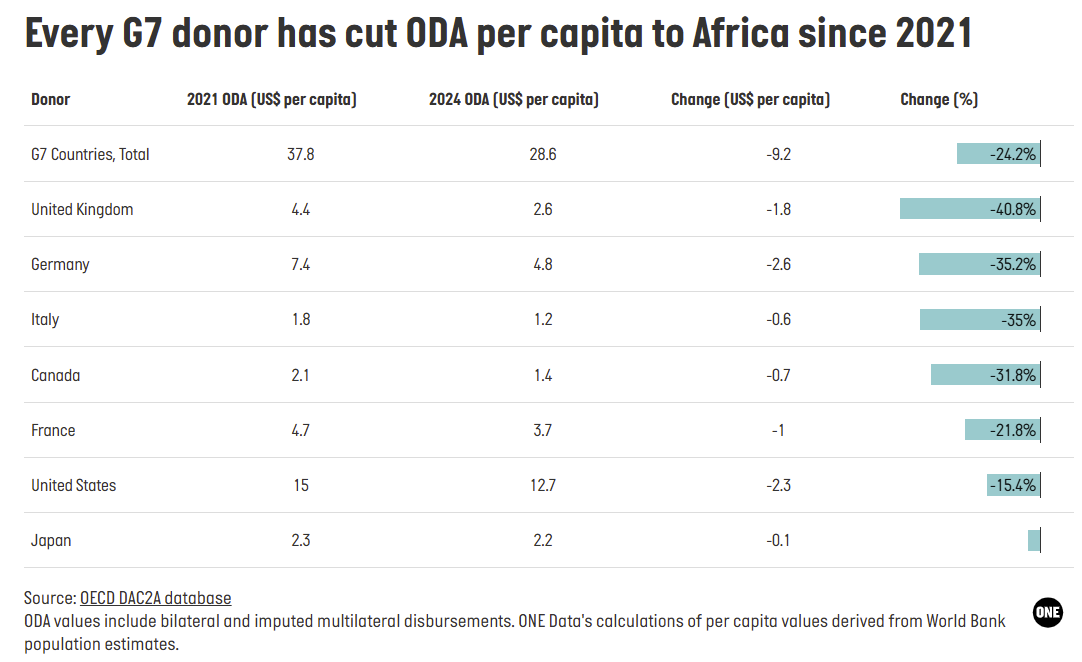
2. Every G7 donor has cut per capita aid to Africa since 2021. The decline is not driven by one donor alone. Across the G7, most major donors provided less aid to Africa in 2024 than they did in 2021. Only Japan provided more aid over that period. But factoring in population growth, even Japan’s per capita aid to Africa fell.
But wait, there’s more (or rather, less): Not only is aid to Africa in decline, but the share of total aid spent in African countries is at its lowest levels in two decades. That means Africa is receiving a smaller share of the pie, as aid gets spent in other places, particularly with the rise of refugee costs in donor countries.
3. Aid to Africa looks likely to continue to fall. Preliminary data from the OECD points to a further drop in aid. Bilateral aid to Africa fell by nearly 24% in 2025, the second consecutive year of decline and the steepest on record. France, Germany, Japan, the UK, and the US accounted for over 95% of the decline. The OECD projects a further 5.8% decline in aid in 2026, a projection that doesn’t account for the impacts of the conflict in the Middle East.
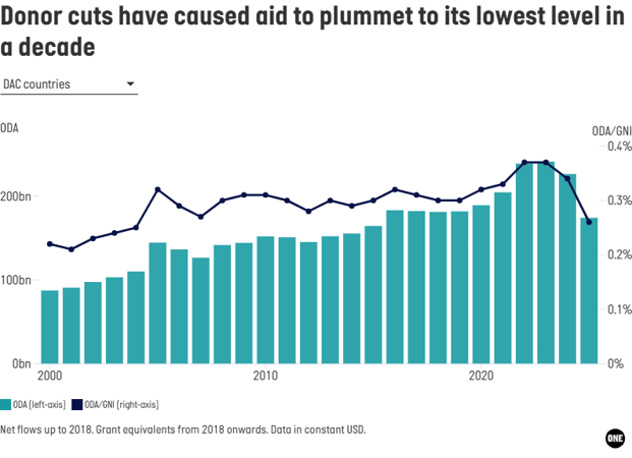
Why it matters: Donors are increasingly trying to do more with less, stretching aid budgets across refugee costs, support to Ukraine, climate finance, private sector instruments, and geopolitical priorities. Those pressures are real. But when the aid pot does not grow, trade-offs become unavoidable. Too often, Africa loses.
FROM THE ONE TEAM:
Ambassador Mark Green, President and CEO of ONE, on the need for countries to mobilise domestic resources to achieve self-reliance.
Ndidi Okonkwo Nwuneli and David McNair on how the Strait of Hormuz shock is a wakeup call for African countries to reduce structural dependence.
Rodney Kazibwe on the disparity between China’s and the US’s trade with Africa.
…
COOL TOOLS:
Jorge Rivera built an open-source Python package that quickly turns messy country, city, and organisation names into clean, standard codes and IDs.
…
IN THE QUEUE:
Why Africa keeps getting the wrong kind of crisis.
“Cooling poverty” affects billions as heat risks rise.
The arithmetic of destruction: How conflict compounds human capital loss.
…
ONE Data provides cutting edge data, tools, and analysis so that we can fight together for a more just world. See for yourself.