

Elephant, meet room
Two spectres plagued this year’s International AIDS Conference, which took place in Brazil this week.
1. The major decline in global funding to combat HIV/AIDS
2. The uneven access to new, transformative drugs
International HIV financing dropped by 18%---more than $1.5 billion—between 2024 and 2025. That’s the lowest level in nearly two decades.
At the same time, multiple drugs that are highly effective at preventing the transmission of HIV have already—or are expected to soon—come onto the market. One of those is lenacapavir, a twice-yearly injectable drug that is nearly 100% effective at preventing HIV transmission. While licensing deals have brought down the high cost of lenacapavir for many low- and middle-income countries, some countries have been excluded from low-cost deals. Without a deal, they (and their citizens) will pay full price—which for many countries is several times their per capita GDP, as we highlight below.
So at the very moment in which game-changing drugs offer the possibility to win the decades-long fight against HIV/AIDS, money—the lack of it and the lust for it—could slow progress.
Millions of people’s lives hang in the balance.
— Joe Kraus, Senior Policy Director, ONE Data
Note: We will be taking a break in August to both recharge and focus on some exciting work we’ll be sharing soon.
3 things to know
1. For the first time, the fight against HIV/AIDS appears winnable. AIDS-related illnesses have claimed more than 44 million lives since the start of the epidemic. At its peak in 2004, the disease killed 2.1 million lives. Since then, pharmaceutical advancements have transformed HIV infection from a death sentence to a manageable disease where people can live long, fulfilling lives (if they have access to drug therapies—which we’ll get to shortly).
New drugs that prevent the transmission of HIV stand to be game changers. Cabotegravir, an antiretroviral drug used for the prevention and treatment of HIV/AIDS, reached the market in 2021. Unlike the other preventative drugs available at the time, which were oral pills, Cabotegravir was novel in that it’s an injection taken every two months. In clinical trials, it achieved a 66%-89% lower HIV incidence compared with people taking oral pills.
Lenacapavir’s effectiveness may be even more impressive. In clinical trials, it was 96%-100% effective at preventing HIV transmission compared to people not taking any preventative drugs. That’s a level of protection comparable to a vaccine. Fifty—or even 15—years ago, that seemed like an impossible dream. Today, it is reality.
Last Friday, Merck announced that it had granted seven licenses to generic manufacturers to produce alimatravir (formerly known as MK-8527), a once-monthly oral pill that helps prevent HIV transmission. That includes four generic manufacturers in India and three in Africa. Those deals will enable the supply of generic alimatravir in 129 low- and middle-income countries.
Alimatravir will provide another important tool in the toolbox to fight HIV/AIDS to meet people’s needs. As an oral pill, it won’t require people to go into a facility to receive injections, yet its monthly regimen may increase adherence over daily pills. Alimatravir does not yet have an announced commercial price, but researchers estimate that generic production at scale could support a price of roughly $3 per person per year.
2. Getting the drugs to those who need them is critical. Even miracle drugs don’t work if not available to those that need them. Here, history is our guide: Many low- and middle-income countries, particularly in parts of Africa most impacted by HIV/AIDS, were priced out of accessing drugs in the 1990s and early 2000s. That helped enable the disease to surge, costing many people their lives.
Despite the incredible progress made over the past three decades, 570,000 people still died from HIV/AIDS in 2025. There are several contributing factors—persistent stigma, weak healthcare systems, and marginalisation—but inability to access life-saving treatments remains an issue.
Fortunately, access to new drugs has improved markedly in recent years. Pharmaceutical companies used to wait to see how phase 3 trials played out before inking manufacturing deals. That is changing. Companies have started getting licensing and manufacturing deals in place while clinical trials are ongoing. That’s enabled them to move much more quickly once trials are concluded and regulatory approvals are secured, cutting the time to generic market entry by as much as three years.
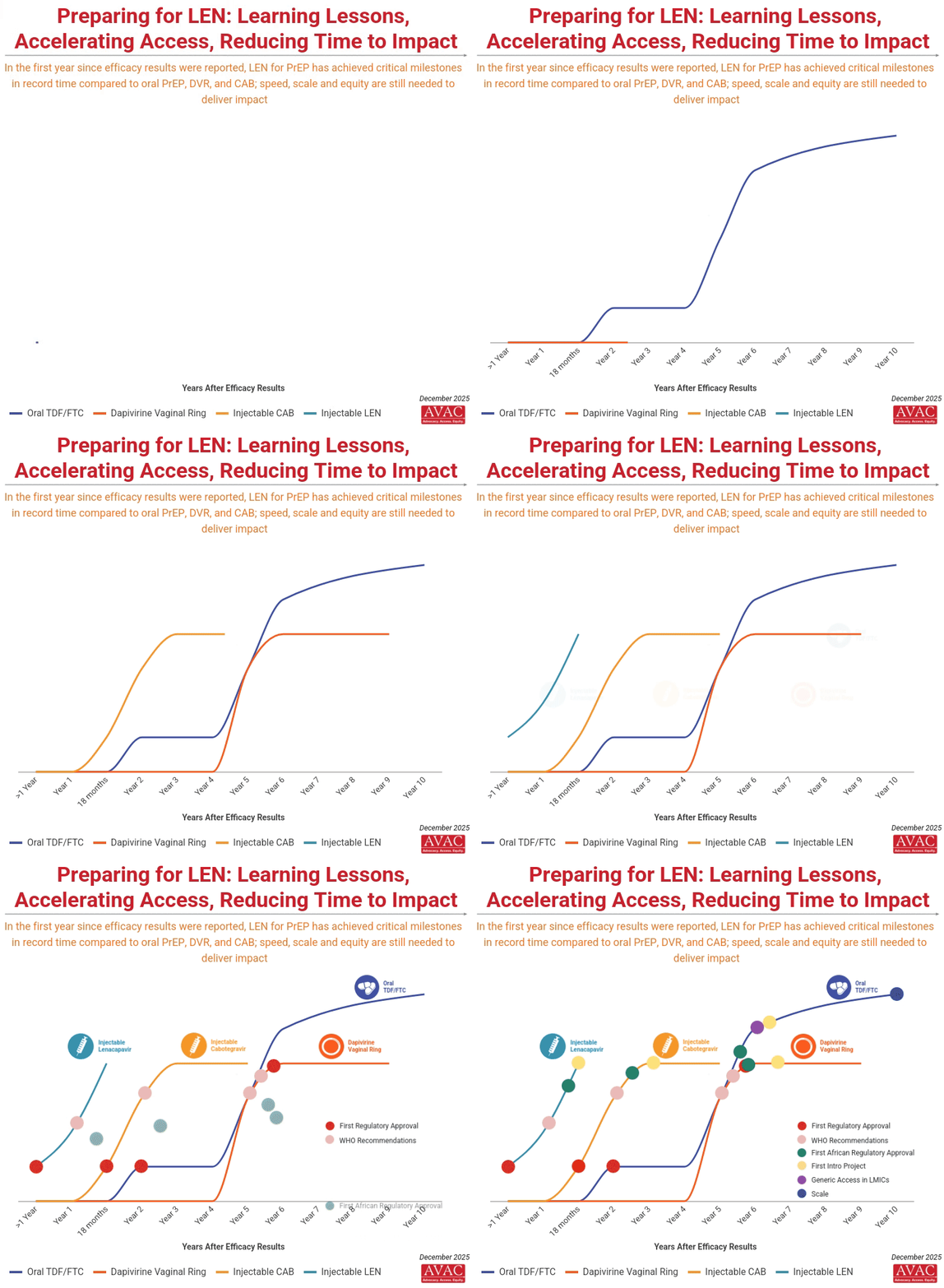
Source: AVAC
As a result, 120 low- and middle-income countries are expected to gain access to lower-cost, generic versions of lenacapavir through Gilead’s voluntary licensing agreements with six generic manufacturers. Until generic production scales up, Gilead has committed to supply the medicine at no profit. Broad generic availability is expected in 2027, bringing the cost down from the US list price of $28,218 to around $40 per year and making this groundbreaking prevention option accessible to more people. The Global Fund and PEPFAR are jointly helping provide access to 3 million people in countries with high HIV burdens. Thus far, demand has outstripped supply for lenacapavir, which will hopefully be addressed as manufacturing scales up and countries get better at managing the rollout.
The rapid progress toward affordable access to long-acting preventative HIV drugs reflects years of collaboration across the HIV community. That includes pharmaceutical innovators, advocates, governments, and philanthropic partners working to shape the market, accelerate voluntary licensing, and ensure that new tools reach the people who need them. But in that regard, there’s still room for improvement….
3. More than two dozen middle-income countries have been excluded from low cost deals. Twenty-five middle-income countries—including three lower-middle income countries—have been excluded from generic licensing deals for lenacapavir. Those countries account for nearly one in four new HIV infections.
“Innovation without access shouldn’t be called innovation. It’s unfairness.” — Brazilian Health Minister Alexandre Padilha, speaking at a press conference on Monday
Latin America, in particular, has been left out in the cold: 11 countries in Latin America are without low-cost lenacapavir deals. That includes Brazil, the host of this year’s International AIDS Conference, as well as Argentina, Mexico, and Peru. Notably, all four countries participated in clinical trials that helped bring lenacapavir to market. [Some of those same middle-income countries—again centred in Latin America—are also excluded from Merck’s generic licensing deals for alimatravir.]
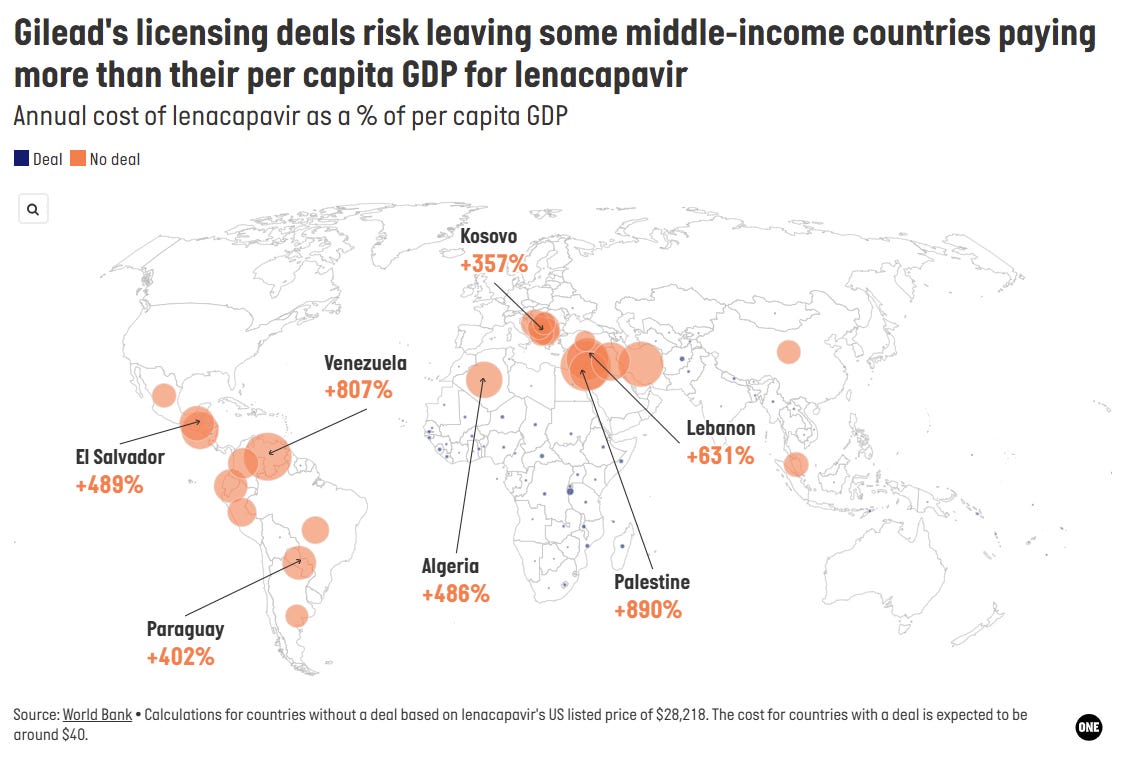
Unless those countries cut a deal with Gilead for lower cost access to the drugs (talks are ongoing), they could end up paying full price. Which, as highlighted in the map above, is more than those countries’ per capita GDPs. That would leave the best defense against HIV/AIDS out of the reach of millions of people, heightening the risk of increased HIV infections and avoidable AIDS deaths.
FROM THE ONE TEAM:
Ambassador Mark Green on the tough choices facing HIV-infected people in lower-income countries.
David McNair and Damilola Ogunbiyi argue in Financial Afrik that the strategic interests of Africa and Europe are converging.
IN THE QUEUE:
South African workers turn to gambling to pay debt.
Smile, you’re starving.
The pathway to prosperity is getting harder for developing countries.
A moving portrayal of life in a refugee camp impacted by Ebola.
ONE Data provides cutting edge data, tools, and analysis so that we can fight together for a more just world. See for yourself.