

Holding the line
Reverend Bienvenu Ndombe first suspected the Ebola response in eastern Congo was a commercial scheme. He had heard that patients taken to the treatment centre never came back. After a community dialogue, he visited the centre with other religious leaders and spoke with patients. “We saw that they were receiving proper care, recovering and returning home,” he says. Now he urges his congregation to seek care early.
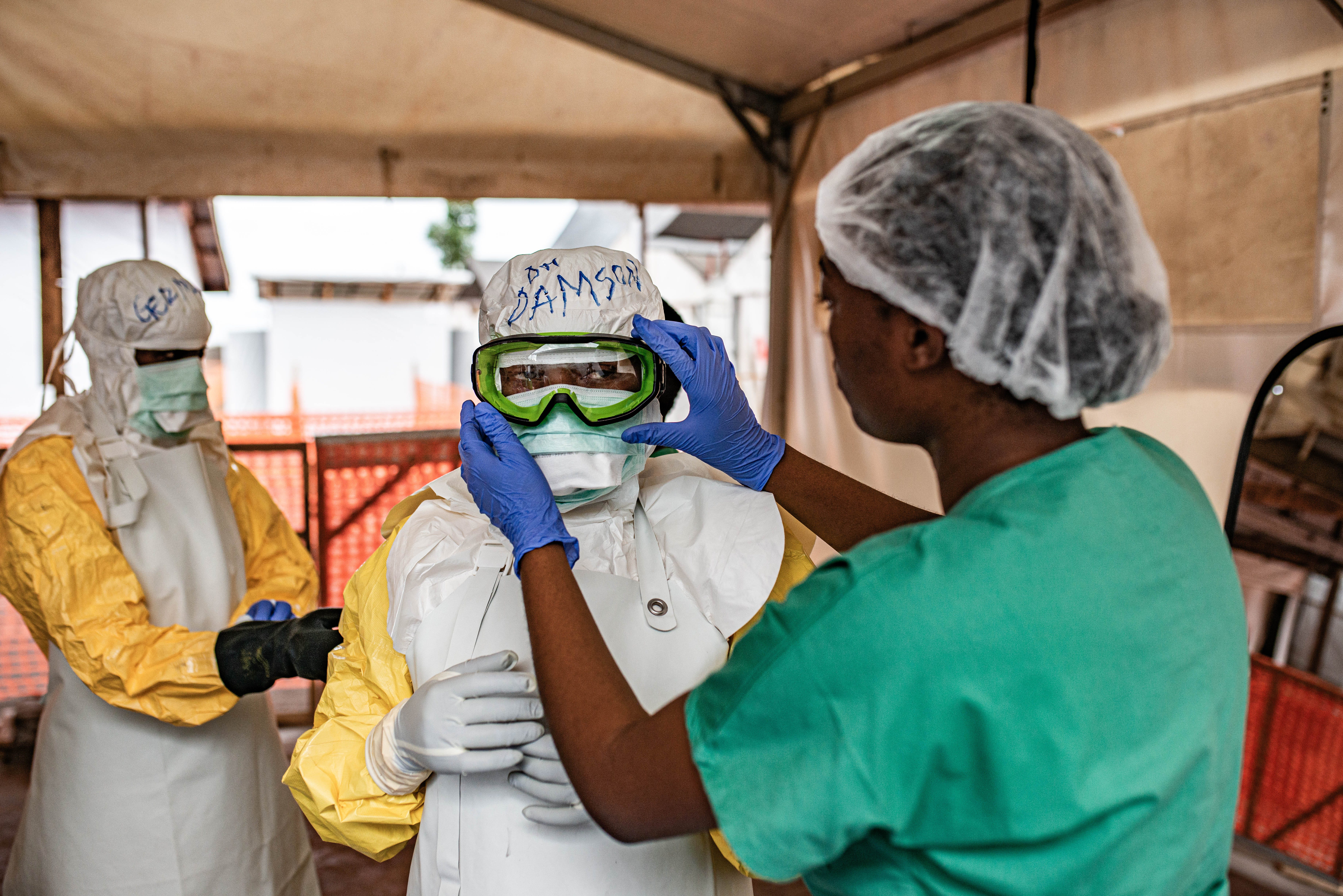
Doubts like his were common. In a June survey of 391 people in Ituri, 60% said there were people in their community who did not believe there was an outbreak. Health workers meet that doubt on the doorstep, and many of them do it unpaid. By 19 October, 301 health workers had been infected and 48 had died.
Responders are also finding ways to bring care closer to home. In Butembo, a mobile laboratory now tests samples on site at an Ebola treatment centre, and the whole lab can be driven to the next community that needs it. Results that once took up to 72 hours come back within 24, and sometimes in as little as six. Suspected patients can be isolated sooner, and people who test negative can return to routine care.
From a distance, an outbreak looks like a curve on a chart. Up close, it looks like a pastor urging his congregation to seek care, a health worker waiting on a doorstep, and a lab that can follow the virus from town to town. Over ten thousand confirmed cases and nearly 5,000 deaths is a staggering toll, and the charts that follow can make it feel far away. Every point on them is a person, and behind each one is a family and a community working out what to do next.
— Micaela Iveson, ONE Data
Three Things to Know
This Ebola outbreak is on track to be the largest on record. There is no licensed vaccine. As of 27 October, 4,964 people (48.6% of confirmed cases) have died from the virus and over 10,224 cases have been confirmed, making it the worst outbreak of Ebola that the DRC has ever seen. The Bundibugyo strain of the Ebola virus is driving the current outbreak, and no licensed vaccine or targeted treatment exists yet to stop it.
West Africa’s 2014–2016 epidemic still remains the deadliest Ebola outbreak ever. But unless conditions in northeastern DRC change, the current outbreak is on track to take that title around the start of 2027.

2. Much of the international funding is not new money. Africa CDC’s tracker counts about $2.9 billion in donor commitments from 40 funders as of 23 September, including $887 million from the United States. ONE Data’s new analysis of donors’ own budget records, which cover more than $2.1 billion of that total, shows how much of it is new. About $1.4 billion was already in donors’ budgets or reserves before the outbreak was declared, in existing programmes, standing emergency reserves and regular aid budgets. About $200 million of that was moved from other work, including $175.7 million the Pandemic Fund took from preparedness projects in nine countries. Only $28.5 million is documented as new money, and the remaining $700 million has no published source.
Donors paid 37% of the DRC’s health spending in 2023, which came to $23 per person, lower than all but three of 193 countries. Then aid fell. Large cuts across donor countries in 2024 and 2025 led to a 23% drop in aid in 2025, in real terms, the largest the OECD has recorded, and the OECD expects health aid to the DRC to be 47% lower in 2026 than in 2024.

3. Northeastern DRC is bearing the brunt of the outbreak. Most confirmed cases have been located in a handful of northeastern provinces near the borders of Uganda, South Sudan, and Rwanda. As of October 25th, 8 of DRC’s provinces had reported cases. Outside of the DRC, a small number of cases have been reported in Kenya, Nigeria and Uganda.
The DRC’s health ministry is spearheading the response, along with support from the World Health Organisation and the Africa Centres for Disease Control and Prevention (Africa CDC). Médecins Sans Frontières (MSF) runs eight treatment centres.

FROM THE ONE TEAM:
Read our full data story on the Ebola outbreak.
Mark Dybul is the new Global Fund Executive Director. Read ONE’s statement on his appointment.
IN THE QUEUE:
Language premium: AI models cost more when you don’t use English.
ONE Data provides cutting edge data, tools, and analysis so that we can fight together for a more just world. See for yourself.