

A hidden global tax
I once spent several months living with a family in rural Uganda. Few people in the village had access to electricity or running water. One of the family members, a 13-year old boy named Mikey, spent his days at the local school and the rest of his time cooking, cleaning, and hauling water from a nearby stream.
Mikey was hardworking and resourceful, but he was not well educated. His school had some 200 students ages 5-18, and one teacher. At night, I would sometimes try to help Mikey with his homework. Two things quickly became clear: There were no textbooks; the students just wrote down what the teacher said, and 2) all of the classes were taught in English. Mikey spoke so little English that most of our communication involved hand gestures and smiles. He wasn’t learning anything.
Mikey’s story is a microcosm of a big problem: Billions of people living in lower-income countries are unable to achieve their full potential because the systems in which they live don’t enable it. Some of them are amongst the most innovative and hardworking people I’ve met. With access to better education and more opportunities, many of them would no doubt do great things.
The unrealised potential of billions of people is an unspoken tragedy of our time. Poverty and inequality are imposing a tax on humanity.
And we are all paying.
— Joe Kraus, Senior Director, ONE Data
3 things to know
1. Untapped potential is the single most significant difference between someone living in a high vs. a lower-income country. The global average for R&D researchers—the people involved in conceiving or creating new knowledge, products, or innovation—is 1,420 per million people. For context, Europe’s average is 3,935, North America’s exceeds 4,800. Denmark’s? 8,736. In contrast, the average number of researchers per 1 million people in low-income countries is 176. In Uganda, it’s 12. TWELVE.
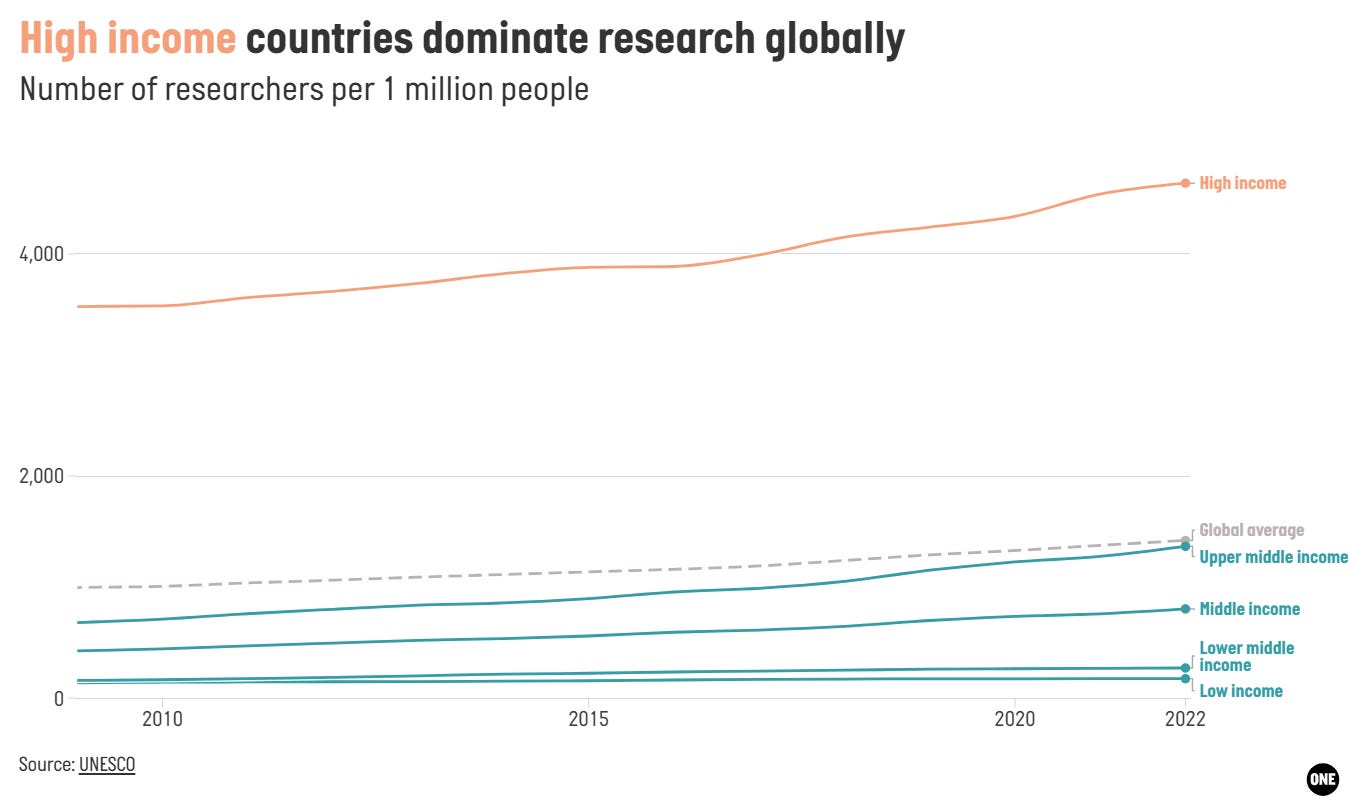
Here’s what that means in practice: Denmark has over 51,000 researchers. Uganda, with a population eight times larger, has fewer than 700. That has obvious implications for the ability of Uganda—or dozens of other countries with relatively few researchers—to discover and develop new innovations, advance their economies, and help people escape poverty. Factors like poverty, poor education, and a lack of electricity, amongst others, limit opportunities for individuals to become researchers and innovators.
2. The disparity between rich and lower-income countries starts at an early age. In most high-income countries, less than 1% of children aged 6-11 are out of school. The average across low-income countries is 21%. In Nigeria—Africa’s most populous country—nearly 1 in 4 children are out of school.
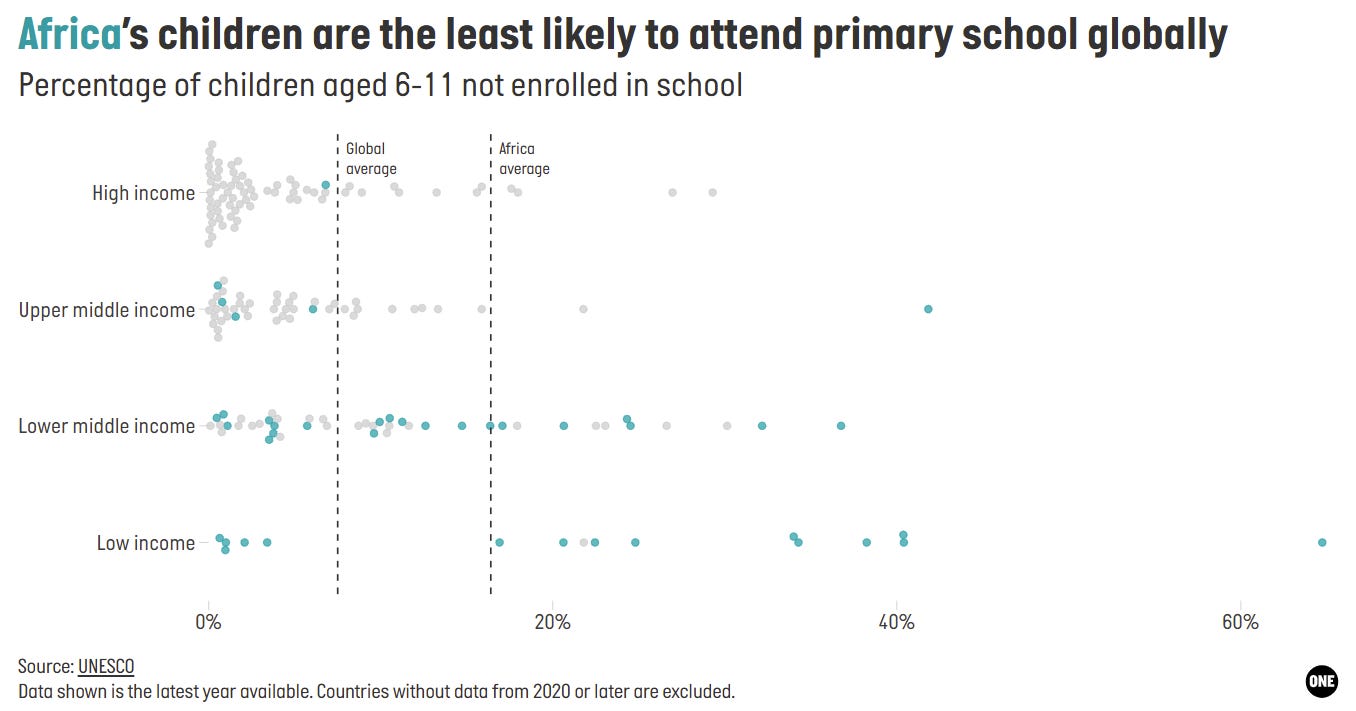
Why it matters: That means that millions of children around the world are not learning the knowledge and skills needed to reach their full potential. And unequal access to primary education impacts higher education levels. Just 8% of Africans over the age of 25 have a bachelor’s degree. That’s half the global average and four times lower than in high-income countries.
3. Having few university graduates results in fewer people with technical expertise. Take IT, for instance. Africa has just four IT professionals per 10,000 people. That’s 10 times below the global average, and 30 times less than high-income countries.
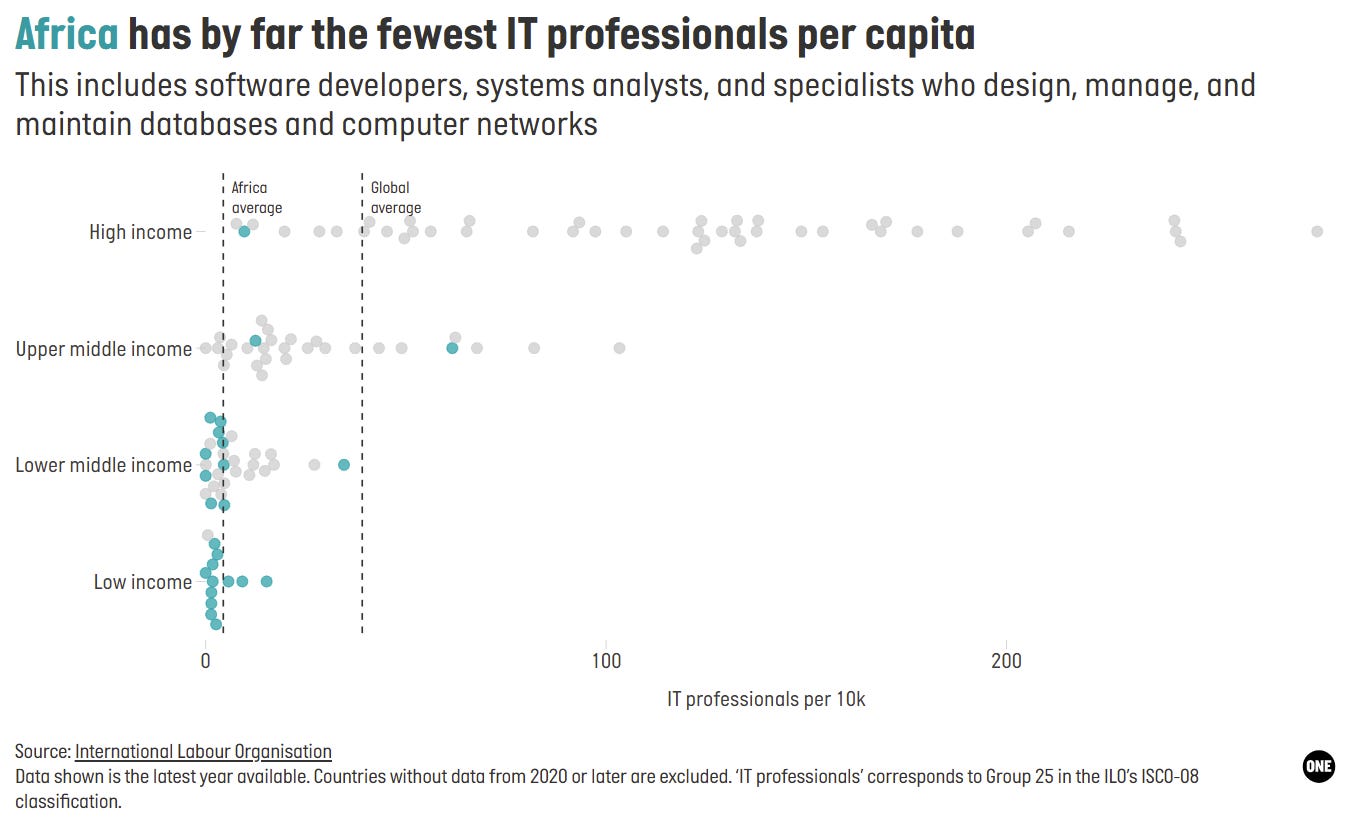
Why it matters: The low number of IT professionals will make it difficult—if not impossible—for African countries to compete in a world in which AI and computer technology dominate. It also significantly diminishes the possibilities for new technology discoveries and tech start-ups. Who knows how many inventions or Apples, Googles, Nvidias, or OpenAIs will fail to be launched as a result?
FROM THE ONE TEAM:
ONE Data’s analysis of shifting development finance flows featured in Devex.
Adrian Lovett’s response to the UK’s disastrous aid cuts featured in The Guardian, Independent, The Telegraph, and Daily Mirror.
Elise Legault and Anthony Salloum highlight a glaring gap in Canadian Prime Minister Mark Carney’s travel itinerary: Africa.
IN THE QUEUE:
African sports fans, doctors, and musicians lament US travel ban.
Africa’s energy revolution must be African-led.
A former Pakistani minister on AI’s potential and dangers for developing countries.
ONE Data provides cutting edge data, tools, and analysis so that we can fight together for a more just world. See for yourself.