

Gutted
One day while doing research for my dissertation in Equatorial Guinea—an oil rich yet poverty-stricken country marred by rampant corruption—I sprinted for cover under an awning to escape a sudden downpour. There, I sat and chatted with a local man I’d never met before and never saw again.
He began to talk about corruption by government elites, no small act in a place where people get arbitrarily arrested, or worse, for criticising the government. At one point he gestured toward a new Mercedes sedan driving by, noting that corruption was what enabled government officials to drive expensive vehicles in a country where most people lack reliable electricity.
As we parted, he said something that both moved me and made me feel incredibly inadequate: “When you leave, don’t forget us.” It was a plea for help by a man surviving in a country where citizens feel powerless against an iron-fisted ruling regime.
Later, I spoke to a civil society activist in the country. He told me that the US Embassy was one of the only places in the country where he and other democracy activists felt safe using the internet without fear of government surveillance. I’ve since encouraged US foreign service members serving in Equatorial Guinea and other democratically-challenged countries to find ways big and small to support the efforts of local activists taking incredible risks.
Until very recently, the US was a champion of democracy, good governance, and human rights around the world. Sure, there were plenty of things it got wrong, but there’s no denying the considerable resources—billions of dollars per year—allocated to the task.
Much of that funding fell victim to the drastic cuts to US aid in 2025. 97% of USAID’s democracy, human rights, and governance portfolio was terminated, and the agency itself dismantled. Over half of the related State Department programs were killed. All told, over $14 billion in US government-funded democracy and governance assistance was cut, affecting work in more than 120 countries.
We’re starting to learn about the consequences of those cuts, and well, it’s not great.
Below, we look at the emerging evidence and what it means for a world in which democracy is on the decline.
— Joe Kraus, Senior Policy Director, ONE Data
3 things to know
1. The US cuts have crippled organisations worldwide. In surveys, respondents have reported that US funding made up over 40% of their organisational budgets. The result has been widespread layoffs, suspended programs, and in some cases, closure.

Source: Global Democracy Coalition
Why it matters: The loss of US funding is significantly weakening the democracy and good governance ecosystems. Civil society organisations and independent media, which play a critical role in pushing for government transparency and accountability, are hampered or disappearing. Repressive regimes are happily doing more repression. As Regina Waugh from the International Foundation for Electoral Systems recounted being told by an activist in an authoritarian country: “My government is so happy that the US doesn’t care about democracy anymore.”
2. An estimated $150 million in annual support for media and internet freedom was lost in the US aid cuts. That includes cuts in places where media already face considerable challenges, like Afghanistan, El Salvador, Nicaragua, and Ukraine. In South Sudan, the only independent national FM radio outlet had to cut three-quarters of its staff. Independent journalists in Myanmar are working without pay.
Why it matters: “Governments are taking advantage of the cuts—and the decreased international attention they entail—to arrest or harass citizens and civil society organisations that have advocated for governance reforms and human rights.” That’s the view of Rene Valiente from the human rights organisation, Cristosal, speaking at a Devex event this week.
She would know: She and dozens of other journalists have fled El Salvador since January 2025 as the country’s strongman leader cracked down on the media and civil society following the retreat of the US’s support for democracy programs. In May 2025, the government passed a Foreign Agents law that imposes a 30% tax on any funding organisations receive from international donors. Nearly all community radio stations in the country received USAID support before the aid cuts; most say that the Foreign Agents law will negatively impact their work and sustainability.
3. The US funding cuts are happening alongside a global deterioration in freedom and civil liberties. Just 7% of the world’s population lives in countries with free or relatively open civic space. Civil society is under severe attack in 122 of 198 countries and territories. And freedom in the world has declined for 19 consecutive years, according to Freedom House.
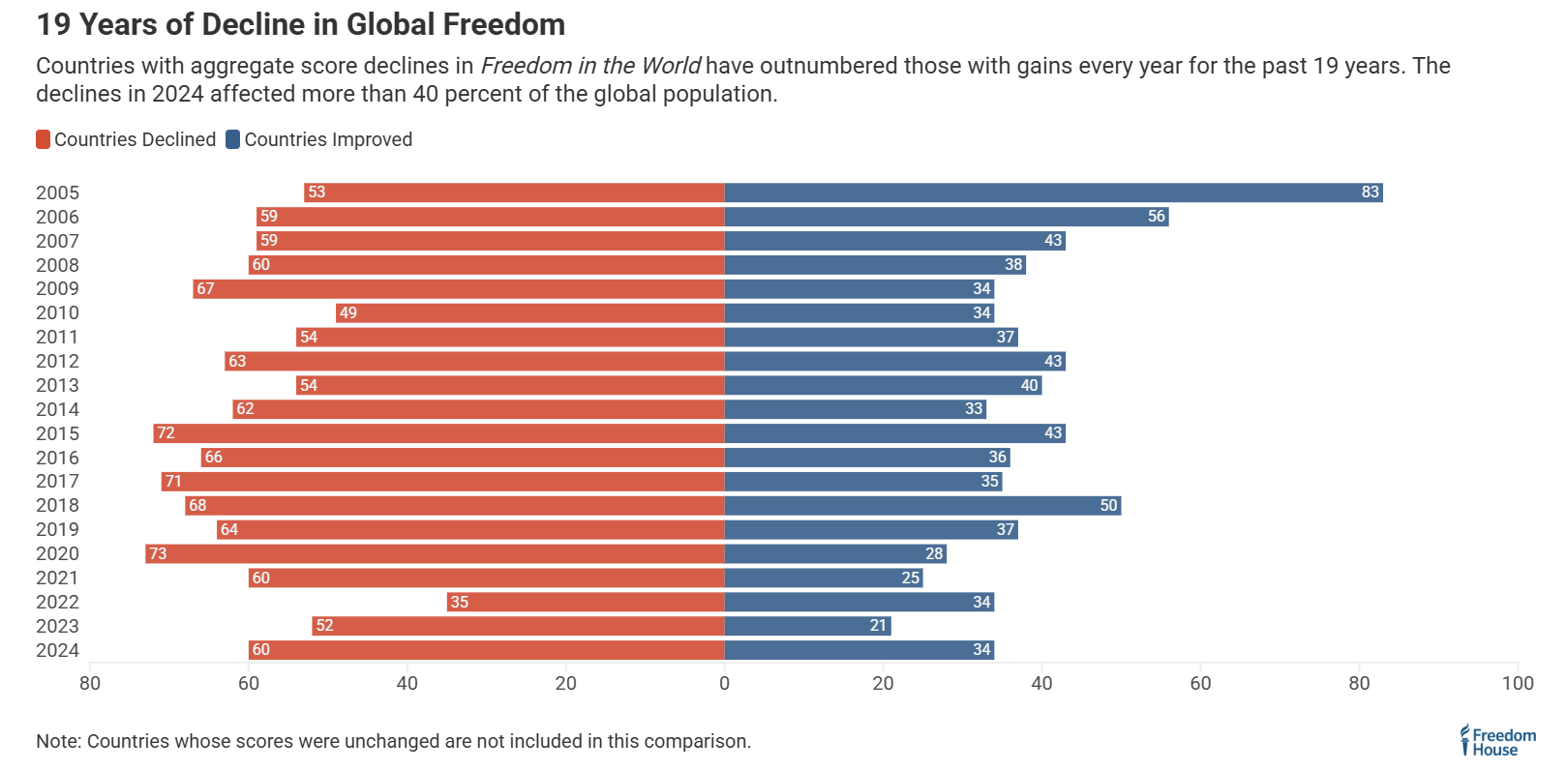
Source: Freedom House
Why it matters: Democratic backsliding isn’t a new phenomenon, but ceding the battle for freedom to authoritarian regimes is. While some other donors—like the EU, Sweden, Norway, Iceland, and certain philanthropies—have upped their funding for democracy and good governance over the past year, they aren’t able to fill the enormous gap left by the US cuts. Nearly 60% of surveyed democracy and rights organisations report having been unable to make up for the loss of US funding from bilateral, multilateral, or philanthropic donors.
FIND DATA FAST
The ONE Data Agent™: An AI-enabled tool that enables you to search tens of millions of data points on health financing in seconds.
Net flows dashboard: Tired of scouring complex databases for developing country data on debt service and loans? Same. So we built an easy-to-use dashboard.
ODA dashboard: Reliable data on aid to developing countries, searchable and downloadable by recipient, sector, and more.
Trade Explorer: Explore, visualise, and download data on annual global trade flows by country and product.
FROM THE ONE TEAM
ONE’s Adrian Lovett on the UK’s failed aid cuts and why it should change course.
IN THE QUEUE
US aid cuts fueled conflict in Africa.
Don’t look now, but the Green Transition is still happening.
ONE Data provides cutting edge data, tools, and analysis so that we can fight together for a more just world. See for yourself.