

The Gambler
You’ve likely seen the headlines about the (many) successful Polymarket bets suspiciously placed just minutes before US military action in Iran and Venezuela.
If you suspected foul play, you weren’t wrong. And not just because the US announced last week the arrest of a special forces soldier who allegedly used classified information about the capture of Venezuelan President Nicolás Maduro to win $400,000 on Polymarket.
New analysis by the Anti-Corruption Data Collective (ACDC) provides additional evidence to validate your suspicions. Looking at bets placed over the past five years, ACDC found that long-shot Polymarket bets on military and defense actions have an average win rate of 52%.
The average win rate on all long-shot bets across Polymarket is just 14%. Bets on politics also outperform the average, with 25% of long-shots paying out.
That strongly suggests that insiders are using confidential (and sometimes classified) information to make money. That could have implications for how political and military decisions get made, and likely rewards a few “well informed” actors to the detriment of everyone else.
So below we take a closer look at prediction market bets and what they may mean for humanity.
— Joe Kraus, Senior Policy Director, ONE Data
3 things to know
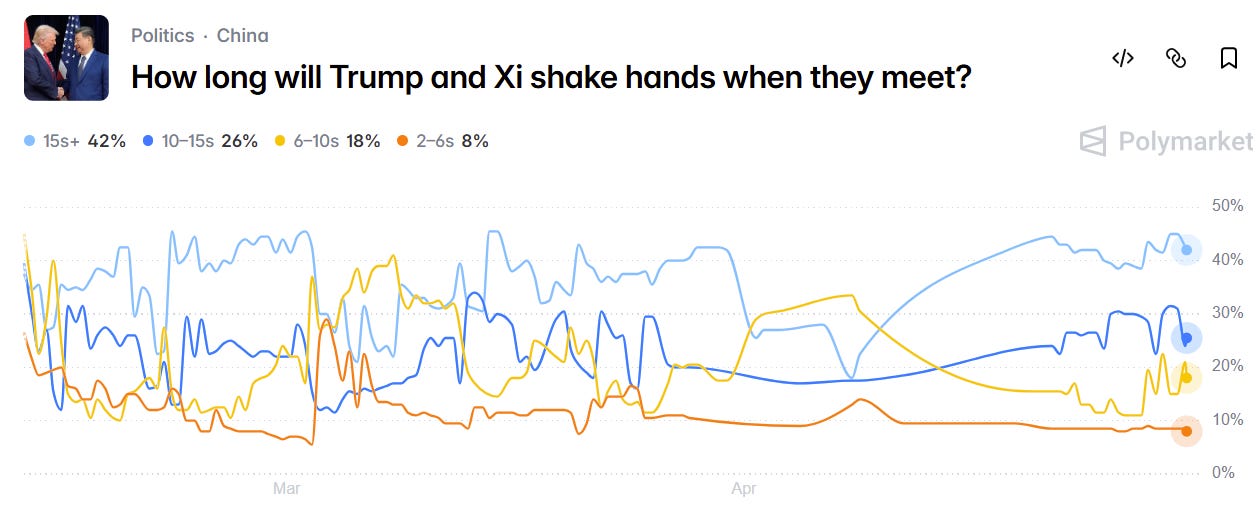
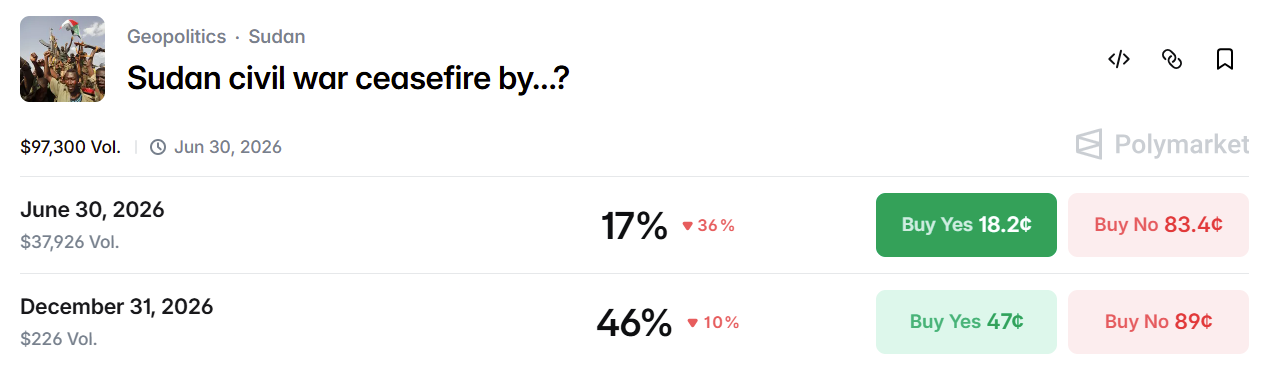
1. Big money is being bet on decisions that impact billions of people’s lives. Millions of dollars are being wagered on whether the price of oil will rise or fall. You can bet on when there will be a ceasefire in Sudan’s civil war. Or whether India will attack Pakistan or China will invade Taiwan. Or whether the US will increase interest rates. Or how long world leaders’ handshakes will last (yes, really). Or who will be the next UN Secretary-General. Or the number of tweets issued by a public figure in a day or week.
Source: Polymarket
Why it matters: Some of these seem like (and may be) harmless fun or simply foolish ways to risk one’s money. But others could have serious implications. For instance, the surge in oil prices since Israel and the US started a war with Iran has entire countries rationing oil, raised fears of recession, and spiked the price of fertilizers. Polymarket bets themselves don’t directly affect oil prices, but they create perverse incentives for people who can affect them. They may decide to use their influence to impact decisions that could be personally beneficial, even if harmful to society. Which raises concerns that…
2. Prediction markets could enable corruption. Prediction markets like Polymarket and Kalshi currently operate in a gray area with little regulation or transparency. That, combined with the potential to make huge profits quickly, increases the risk of abuse. It doesn’t take a criminal mind to imagine scenarios where people could use non-public information to their advantage. Like legislators or their aides betting on outcomes over which they have influence. Government officials placing surefire bets on events they are about to set in motion. Two warring factions refusing to a ceasefire because they’ve literally bet against it.
Source: Polymarket
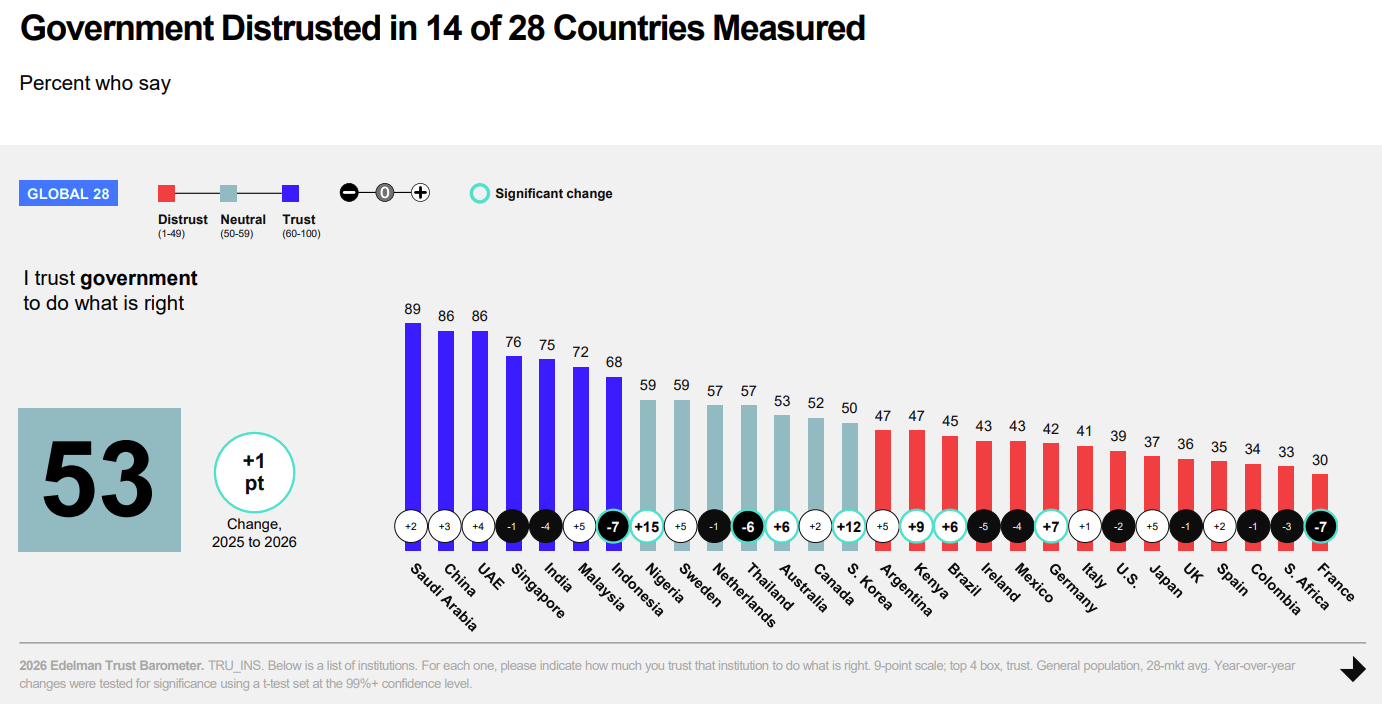
Why it matters: The social contract is premised upon the idea that governments act in the interests of their citizens. When that doesn’t happen it erodes people’s trust in government and frays the social contract. If it persists, it can unravel the social fabric, lead to political instability, and increase the risk of violence. With people’s trust in government already low and impunity on the rise in many parts of the world, largely unregulated prediction markets risk further eroding an already troubling trust trend.
Source: 2026 Edelman Trust Barometer Global Report
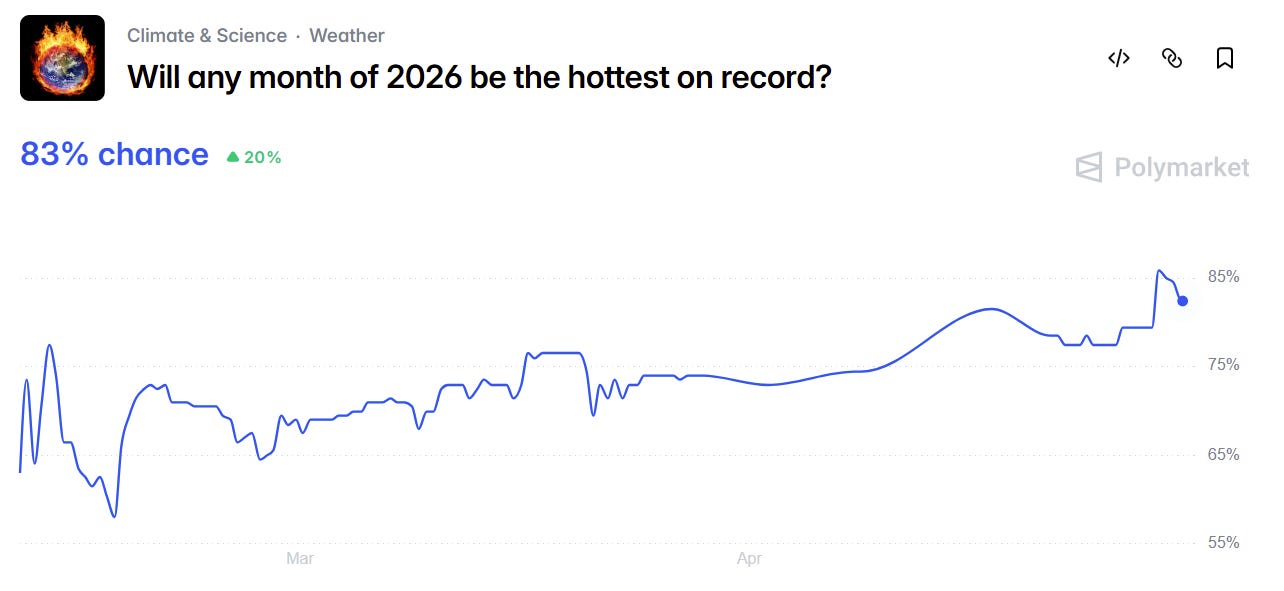
3. You can literally gamble on the world’s demise. In early March, after public backlash, Polymarket pulled down markets that allowed people to bet on the possibility of nuclear war. You can place bets on the high temperatures in cities around the world, which while arguably harmless is a bit off-putting when you consider that heat waves and droughts are becoming the norm rather than the exception, with millions of people suffering through both each year.
Source: Polymarket
Why it matters: Prediction markets risk turning things like elections, geopolitics, and climate change into a kind of monetisable game or spectator sport rather than events with serious consequences. Bettors have even started pressuring people to change facts so they can win bets. What happens when elections or geopolitics start to feel transactional? What does rooting for hotter temperatures to win a bet do to one’s empathy? We are on a path to finding out.
FROM THE ONE TEAM:
Can nowcasting lead to better real-time estimates of aid flows? We’d welcome feedback on our ideas.
ONE Data’s debt analysis featured in a Health Policy Watch story about African leaders declaring the end of the aid era.
David McNair on what progressives are finally learning from the far right.
IN THE QUEUE:
New analysis suggests something fishy is happening on Polymarket.
AIDS creeps back in parts of Zambia, a year after US cuts to HIV assistance.
Critical minerals demand fuels poverty and pollution in poorer countries.
ONE Data provides cutting edge data, tools, and analysis so that we can fight together for a more just world. See for yourself.