

Fueled up
There’s been no shortage of warnings that higher oil prices stemming from the US-Israeli war with Iran could prove devastating for developing countries (including our contribution to the genre back in March). Thus far, the impacts have been uneven.
That’s because governments have taken different approaches to managing the disruptions caused by the war. Some have taken the higher costs on the chin, absorbing them through subsidies or tax cuts rather than passing them onto consumers. Others have done the latter. That’s resulted in vastly different prices for fuel from one country to the next.
The price of diesel is illustrative. Despite the market establishing a clear global price, there’s enormous variance in how that price gets internalised at the national level. One study of 42 African countries found that each has handled the 2026 oil shock differently. Below we take a closer look at the war’s uneven impact on the price of diesel, and what it means for African countries.
— Joe Kraus, Senior Policy Director, ONE Data
4 things to know
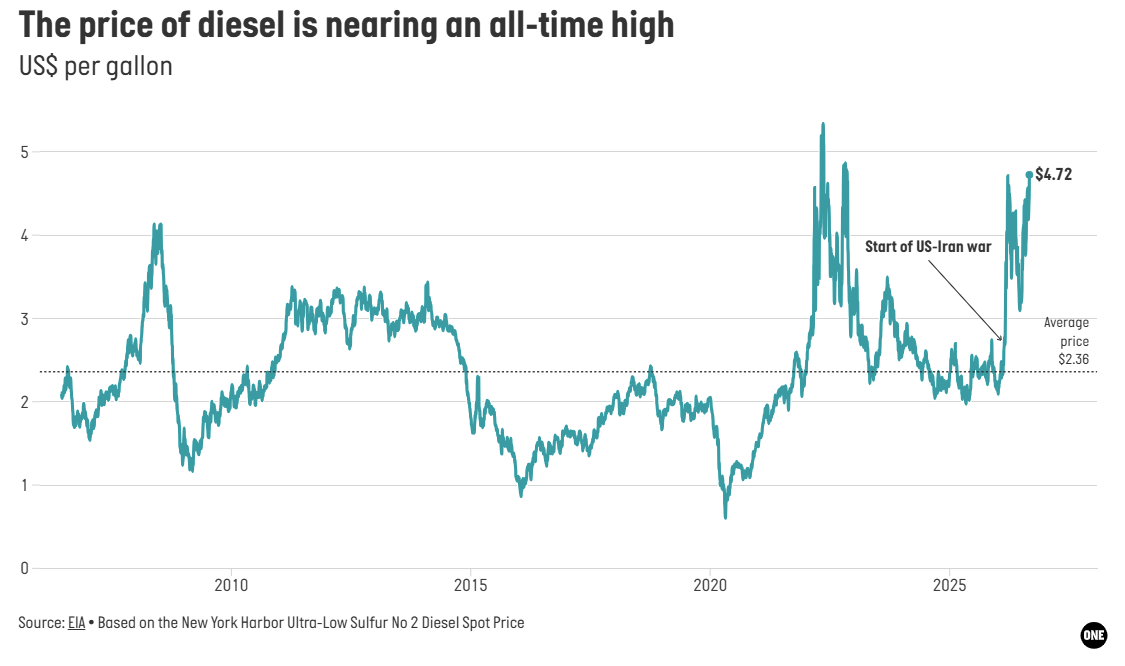
1. Diesel prices are double their 20-year average. Since the US-Israeli war with Iran began on 28 February, disruptions around the Strait of Hormuz have pushed Brent crude oil from roughly $69 a barrel immediately before the war to nearly $120 in March. That caused diesel prices to surge. Prices retreated in May and June, but have spiked again in the face of renewed US-Iran hostilities. This week the price of diesel hit its highest level since the record set in May 2022 following Russia’s invasion of Ukraine.
Explore an interactive version
Supply disruptions have rerouted Africa’s diesel imports from the Middle East to Asia. The longer transport routes may further increase the price African consumers pay, and leave African countries more susceptible to new supply disruptions
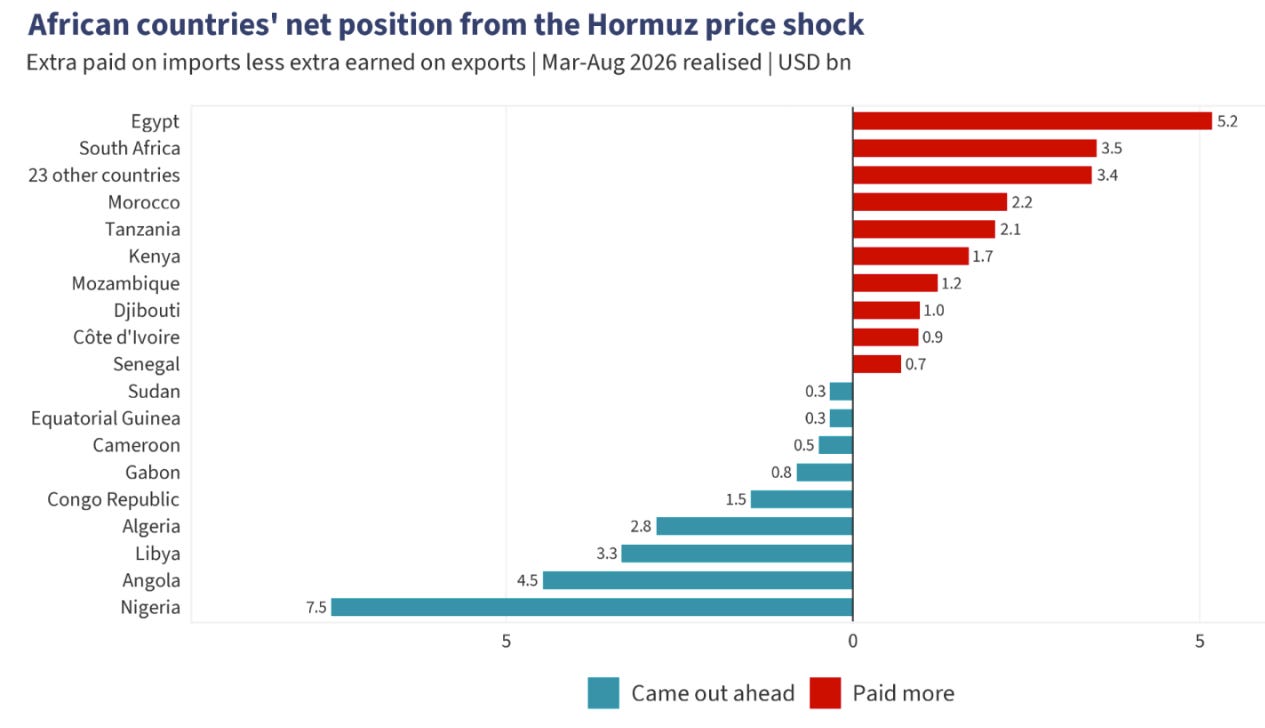
2. Africa’s net fossil fuels imports obscure the war’s true impact. Between March and August, Africa’s net fossil fuel imports were $300 million. That’s a rather modest trade imbalance, all things considered. That number, however, hides the fact that 32 of the 41 countries with data paid higher costs for imported fuels. In the data, those costs get offset by the higher earnings of nine fuel exporting countries.
Source: The Centre for Research on Energy and Clean Air
Digging into the numbers reveals just how differently diesel prices are being felt across Africa. Motorists in Sierra Leone are paying nearly 10 times the cost of diesel in Algeria. Egypt has absorbed an estimated $5.2 billion in additional fuel costs this year—equivalent to about 1.33% of GDP—South Africa $3.5 billion, and Morocco $2.2 billion. Conversely, Africa’s leading oil exporter, Nigeria, gained about $7.5 billion, with Nigeria, Angola, Libya and Algeria together accounting for over $18 billion of exporter gains.
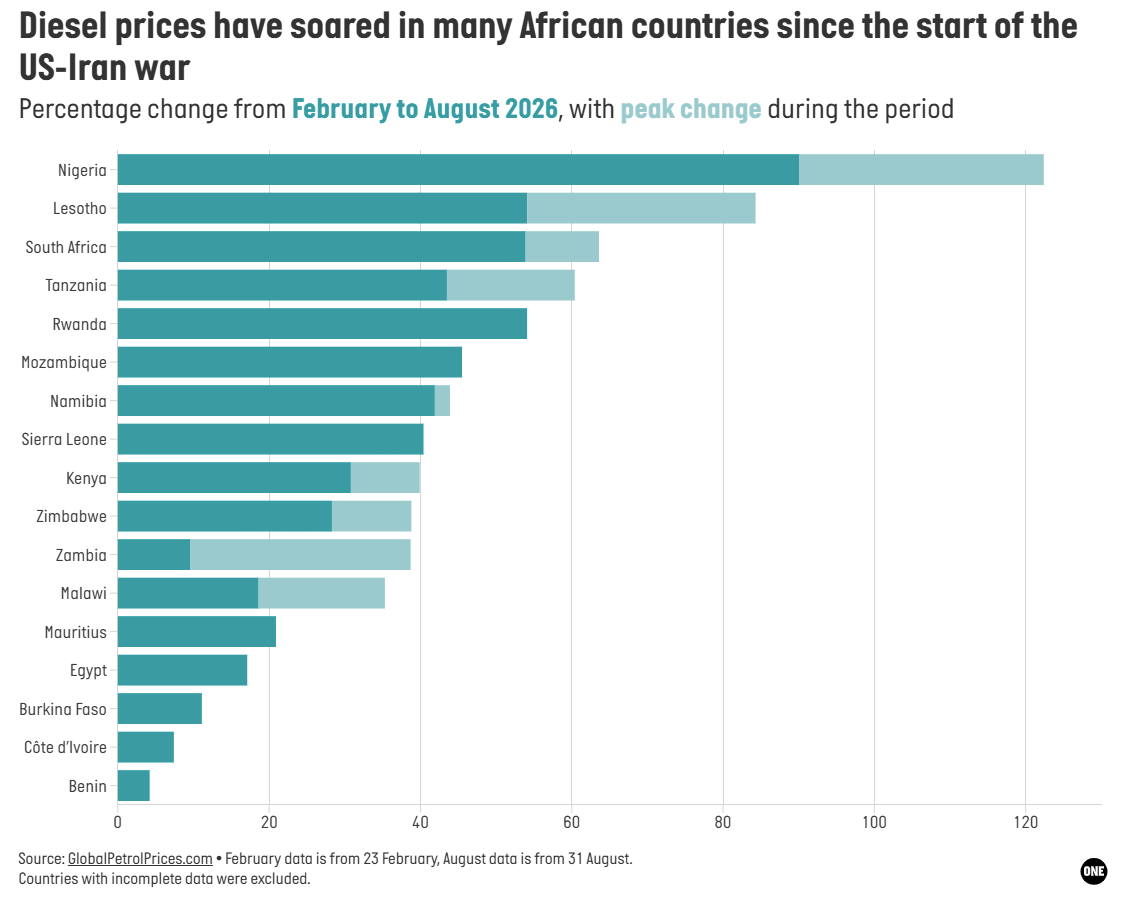
3. Fuel prices are hitting ordinary people hard. Ethiopia could secure only 60% of its normal monthly diesel imports in March and April, resulting in diesel rationing, long lines at filling stations, and higher produce prices in the capital, Addis Ababa. Diesel prices in Nigeria surged 122% in April compared to pre-war prices, and remain 90% higher today. A similar pattern is visible across Africa.
Explore an interactive version
A range of factors influences how much of the higher global fuel prices reach consumers. That includes domestic taxes, government subsidies, currency exchange rates, and price controls. That explains why diesel prices vary so dramatically. A dozen African countries—including Algeria, Angola, Burkina Faso, Cameroon, and Tunisia—have used price controls to protect consumers, often through the use of subsidies. But consumers end up paying eventually, directly or indirectly. The price tag for governments can be high, cutting into government revenues or crowding out other government spending. Price controls can encourage excess fuel consumption and tend to disproportionately benefit wealthier households that consume more fuel.
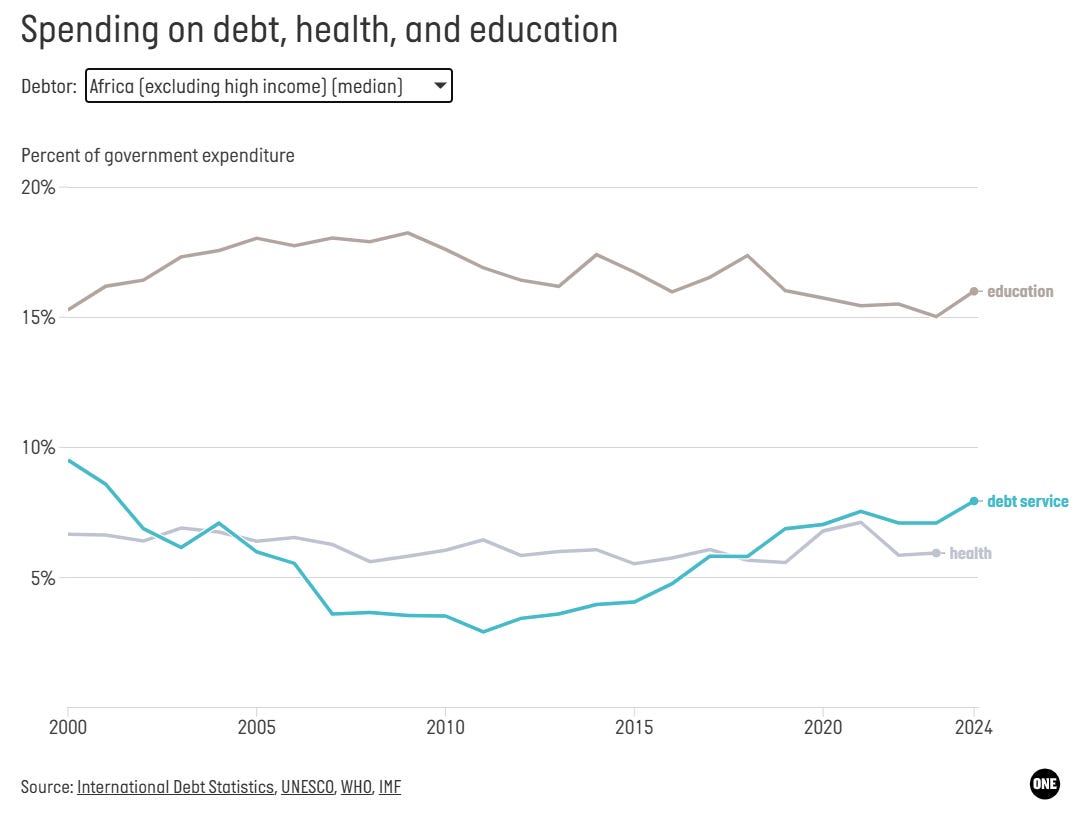
4. Rising fuel prices are captaining the SS Double Whammy. Higher fuel prices are contributing to inflation concerns, a catalyst for the recent global bond-market selloff. That selloff holds troubling implications for developing countries: As bond prices fall, yields rise, making it more expensive for governments to issue new debt or refinance existing debt. That’s bad news for countries with high debt burdens. Thirty-two countries are already in (or at high risk of) debt distress, including 21 low-income countries in Africa. Higher fuel prices are a double whammy, squeezing government budgets while making it less feasible to borrow their way out of a tight spot. Over half of African countries already spend more to service their debt than they do on health. Higher fuel prices will make reversing that trend even harder.
Explore an interactive version
FROM THE ONE TEAM:
Adrian Lovett on the impact rising oil prices could have on developing country debt.
David McNair summarises the outcomes of this week’s G20 Finance Ministers meeting.
IN THE QUEUE:
Behind the Nepal-China border floods lie bad politics.
Africa needs five boring things, not more plans.
Who gets to explain development?
ONE Data provides cutting edge data, tools, and analysis so that we can fight together for a more just world. See for yourself.